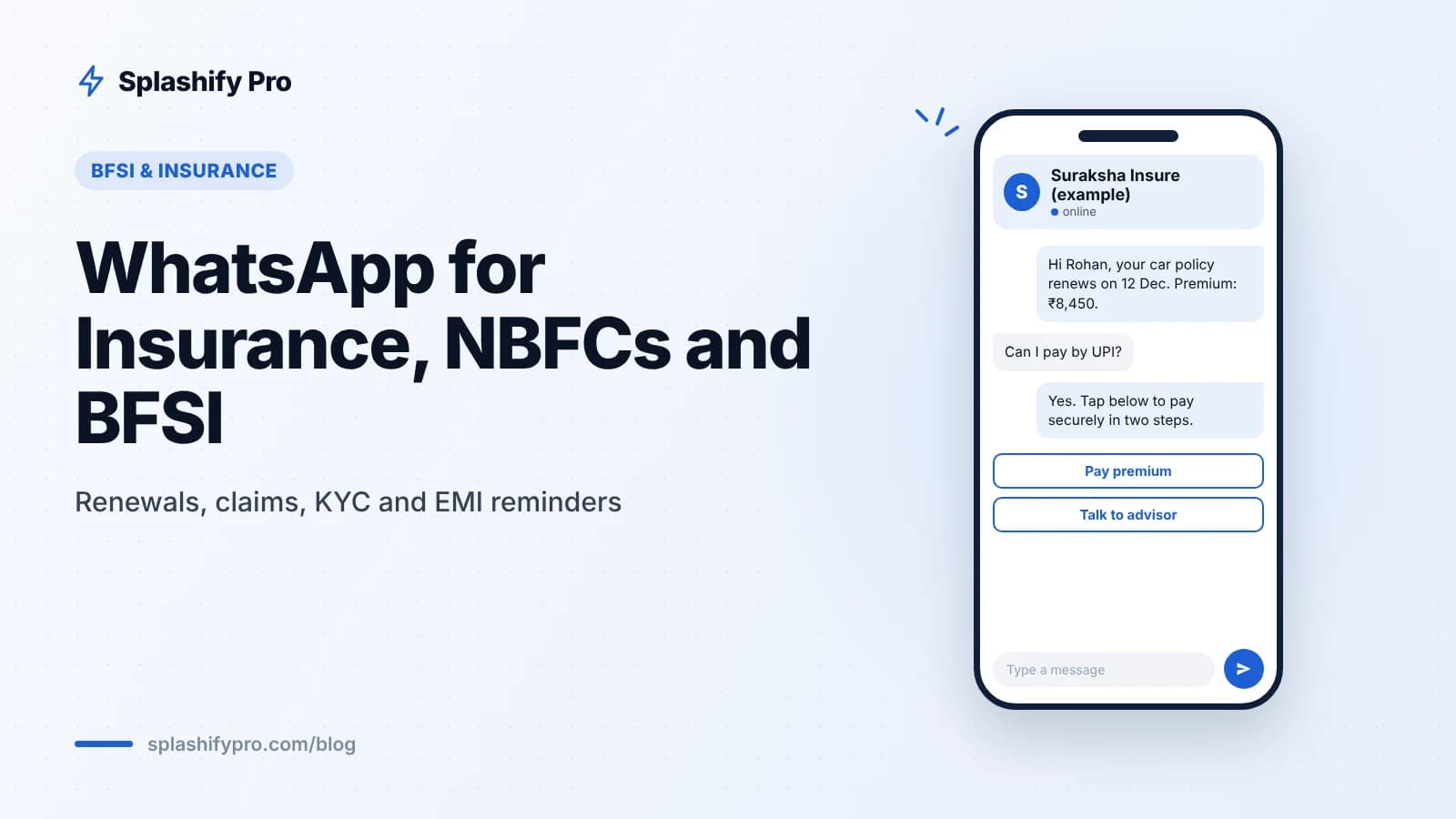
A policy lapses because the renewal email landed in spam. A borrower misses an EMI because the SMS looked like every other bank alert. For insurers, NBFCs, brokers and other BFSI businesses in India, WhatsApp is where customers already read and reply, which makes it a strong channel for renewals, claims updates, KYC and collections, as long as consent and data handling are done with care.
Why BFSI teams are moving key journeys to WhatsApp
Financial services communication has two jobs: reach the customer at the right moment and get them to act. Email open rates are unpredictable and SMS is a one-way, text-only channel. The WhatsApp Business API adds a few things BFSI teams care about:
Two-way conversations. A customer can reply "I already paid" or "What is my claim number?" and get an answer from a bot or an agent in the same thread.
Rich content. Send policy PDFs, premium receipts, EMI schedules and payment links, with quick-reply buttons for the next step.
Verified identity. A business display name and profile reduce the "is this a scam?" hesitation that hurts fraud-wary customers.
Automation with handoff. Bots handle routine status queries; complex claims or disputes move to a trained human in a shared inbox.
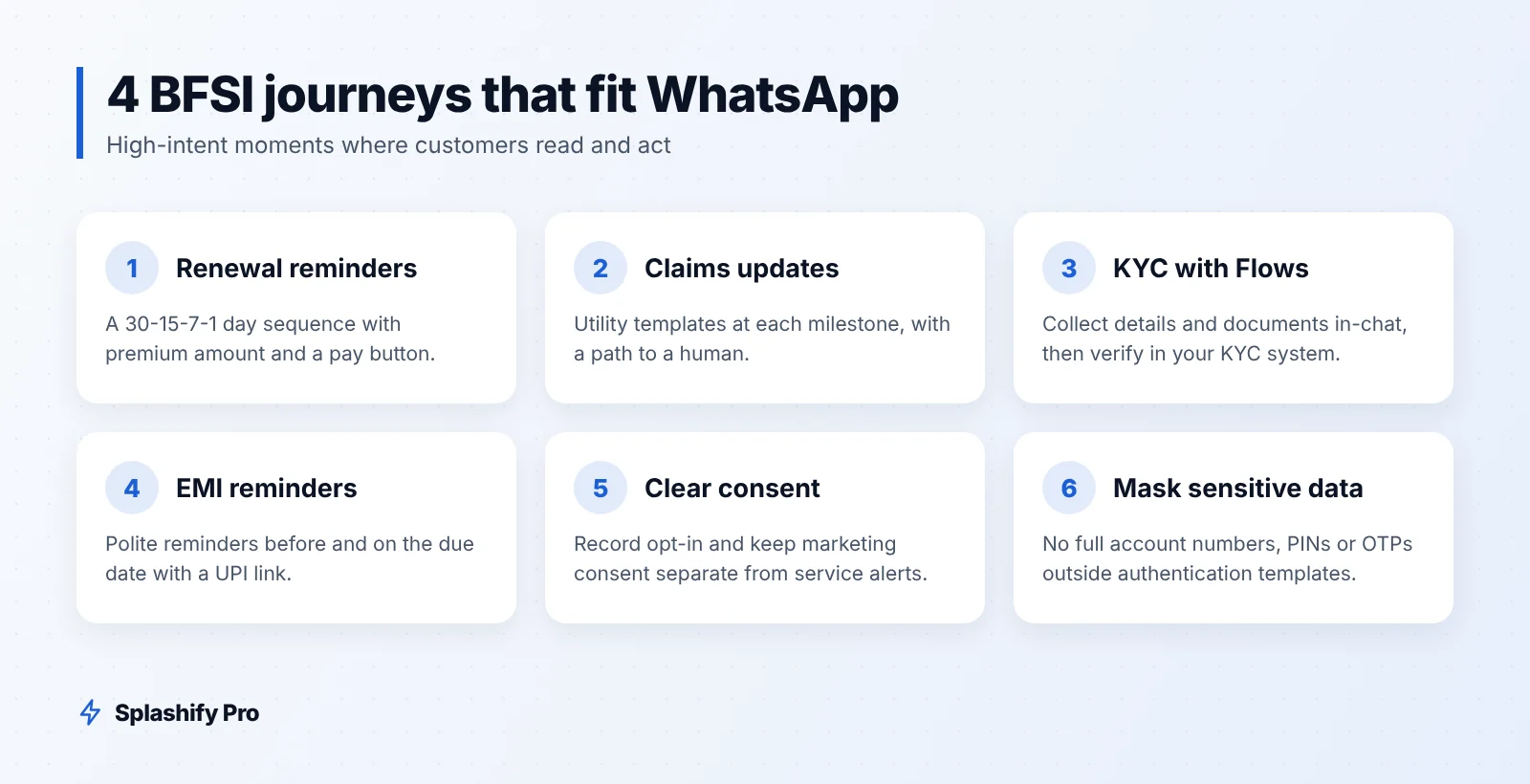
Use case 1: Policy renewal reminders
Renewals are the highest-value flow for most insurers and brokers. A timed sequence works better than a single reminder. Here is a sequence many teams start with:
When | Message | Buttons |
|---|---|---|
30 days before due date | Renewal notice with premium amount and policy PDF | Renew now, Talk to advisor |
15 days before | Reminder with payment link | Pay premium, Remind me later |
7 days before | Reminder highlighting what cover is at stake | Pay premium, Call me |
1 day before | Final reminder | Pay premium |
During grace period | Grace period notice and lapse date | Pay premium, Need help |
A sample renewal template:
Hi {{1}}, your {{2}} policy ending {{3}} is due for renewal on {{4}}. Premium: ₹{{5}}. Renew before the due date to keep your cover active without a break.
Keep renewal reminders strictly about the existing policy. Once you add "upgrade to a higher sum insured" or a cross-sell, Meta will usually classify the template as marketing, which costs more per message.
Use case 2: Claims status updates
Claims are where trust is won or lost. Customers want to know what is happening without calling a helpline. Send a utility template at each milestone:
Claim registered, with claim reference number
Documents pending, with a list of what is missing
Surveyor or inspection scheduled
Claim approved or settled, with amount and expected credit date
Claim queried or rejected, with a "Talk to an agent" button
The last step matters most. A rejection message should always open a path to a human. In Splashify Pro, a button tap can assign the conversation to the claims team in the shared team inbox, with the claim ID visible in the contact's custom fields.
Use case 3: KYC document collection with WhatsApp Flows
Collecting KYC documents over email or by asking customers to "send a photo here" creates messy, unstructured data. WhatsApp Flows let you build form-like screens inside the chat: text fields, dropdowns, date pickers and photo or document upload components.
A typical KYC or onboarding Flow for an NBFC might cover:
Basic details: name as per PAN, date of birth, address
Employment type and income range from a dropdown
Upload of required documents as per your KYC policy
Consent checkbox with a link to your privacy notice
Treat the Flow as a collection step, not the verification itself. Pass the submission to your existing, regulated KYC process for verification, and store documents in your own secure systems rather than leaving them sitting in chat threads. Ask only for what your KYC policy requires.
Use case 4: EMI and premium payment reminders
For NBFCs, microfinance lenders and BNPL players, EMI reminders are the bulk of WhatsApp volume. A polite reminder three days before the due date, another on the due date, and a follow-up after a missed payment covers most cases. Add a UPI or payment gateway link so the customer can pay in two taps. Our guide to WhatsApp payment reminders has more template examples.
Tone matters here. Follow your regulator's guidelines on fair practices and recovery conduct, avoid threatening language, and respect reasonable contact hours. A reminder that reads as harassment will be reported, which hurts your quality rating and can restrict your number.
Compliance care: consent, content and data
BFSI messaging carries more risk than retail promotions. Build these rules into your templates and processes from day one.
Get clear opt-in
Capture WhatsApp consent at onboarding, on proposal forms, in your app or on your website, and record when and where it was given. Our WhatsApp opt-in guide covers the details. Keep marketing consent separate from service consent so a customer can stop offers without losing policy alerts.
Keep sensitive data out of templates
Fine to include | Keep out of messages |
|---|---|
First name | Full account, card or policy numbers (mask them, e.g. last 4 digits) |
Due date and amount | Passwords, PINs, CVV |
Masked reference numbers | Full Aadhaar or PAN numbers |
Claim status | Health or medical details beyond what the customer needs |
Secure links to your portal | Login credentials or OTPs outside authentication templates |
Use dedicated authentication templates for OTPs, and remind customers that your staff will never ask for their PIN or OTP.
Prepare for DPDP
India's Digital Personal Data Protection rules are coming into force in phases. The Consent Manager framework becomes operative on 13 November 2026, and the core obligations on notice, consent, security safeguards, breach intimation, data principal rights and retention become enforceable on 13 May 2027. Penalties for security safeguard failures can reach ₹250 crore. Our guide to DPDP consent for WhatsApp marketing covers the timeline. Map where WhatsApp data flows in your stack, set retention periods, and make it easy for customers to withdraw consent. This is general information, not legal advice; check with your compliance team or counsel.
What a renewal programme costs
From 1 October 2026, India rates before 18% GST are ₹0.115 per delivered utility or authentication message and ₹0.8631 per delivered marketing message. Consider a hypothetical Pune insurance broker with 10,000 renewals due in a quarter, sending four utility reminders each:
40,000 utility messages × ₹0.115 = ₹4,600 before GST
Replies inside the 24-hour window: the first 1,000 service messages per number per month are free, then ₹0.115 each
Compared with the premium value of even a handful of saved renewals, the messaging cost is small. Use our WhatsApp pricing calculator to model your own volumes.
Setting it up on Splashify Pro
Connect your number through the official WhatsApp Business API onboarding.
Create utility templates for renewals, claims and EMIs in the template manager. Most templates are approved within 24 hours.
Sync due dates from your policy or loan system using the public API, webhooks or Google Sheets.
Build drip sequences for renewal and EMI reminders, and a WhatsApp Flow for KYC collection.
Add an AI agent for FAQs like "how do I download my policy?" with handoff to humans for claims and disputes.
Frequently asked questions
Are renewal and EMI reminders utility or marketing messages?
Reminders about an existing policy or loan, with no promotional content, are generally accepted as utility. Meta decides the category at approval, so keep cross-sells out of these templates.
Can we collect KYC documents on WhatsApp?
You can collect details and documents with WhatsApp Flows, then verify them through your regulated KYC process. Collect only what your policy requires and store it securely in your own systems.
Is WhatsApp allowed for financial services in India?
Many banks, insurers and NBFCs in India use the WhatsApp Business API. Meta's commerce and business policies apply, along with your regulator's rules, so review both with your compliance team.
Should we send full policy numbers on WhatsApp?
Mask them. Show the last few digits and link to your secure portal for full details.
The bottom line
For insurance and BFSI, WhatsApp works best on high-intent moments: renewals, claims, KYC and payments. Start with utility templates, mask sensitive data, keep consent records clean and give every customer a path to a human. Start your 7-day free trial of Splashify Pro (no credit card needed), or book a demo to map your renewal and claims journeys with our team.
- #bfsi whatsapp
- #emi reminders whatsapp
- #kyc whatsapp flows
- #policy renewal reminders
- #whatsapp for insurance
- #whatsapp for nbfc