2026 has been the busiest year for WhatsApp Business API changes since Meta moved to per-message pricing. Billing rules, bidding, user identity, AI agents and currency have all shifted, and most of it lands on your invoice or your code. Here is every change that matters for Indian businesses, and a short list of what to do in November.
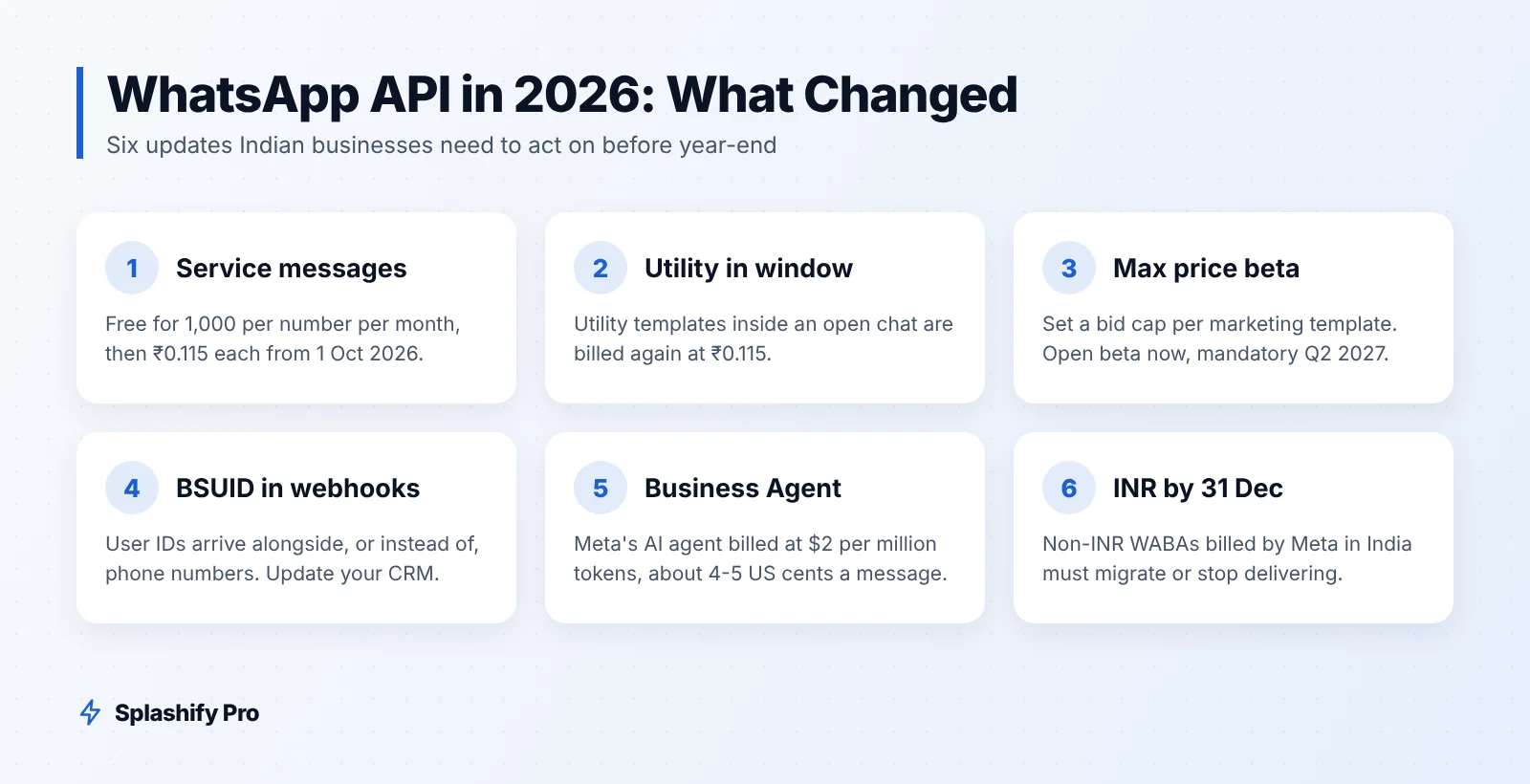
The 2026 changes at a glance
Change | Date | Who it affects |
|---|---|---|
Service messages billed after 1,000 free per number | 1 Oct 2026 | Every API user with support traffic |
Utility templates billed again inside the 24-hour window | 1 Oct 2026 | Order updates, reminders, alerts |
Max price (bid cap) for marketing messages | Open beta Oct 2026 | Anyone sending marketing templates |
Business-scoped user IDs (BSUID) in webhooks | From April 2026 | Developers, CRMs, integrations |
Meta Business Agent billed by tokens | 1 Aug 2026 | Businesses using Meta's own AI agent |
Non-INR WABAs must move to INR | Deadline 31 Dec 2026 | Accounts billed by Meta in another currency |
1. Service messages are no longer unlimited and free
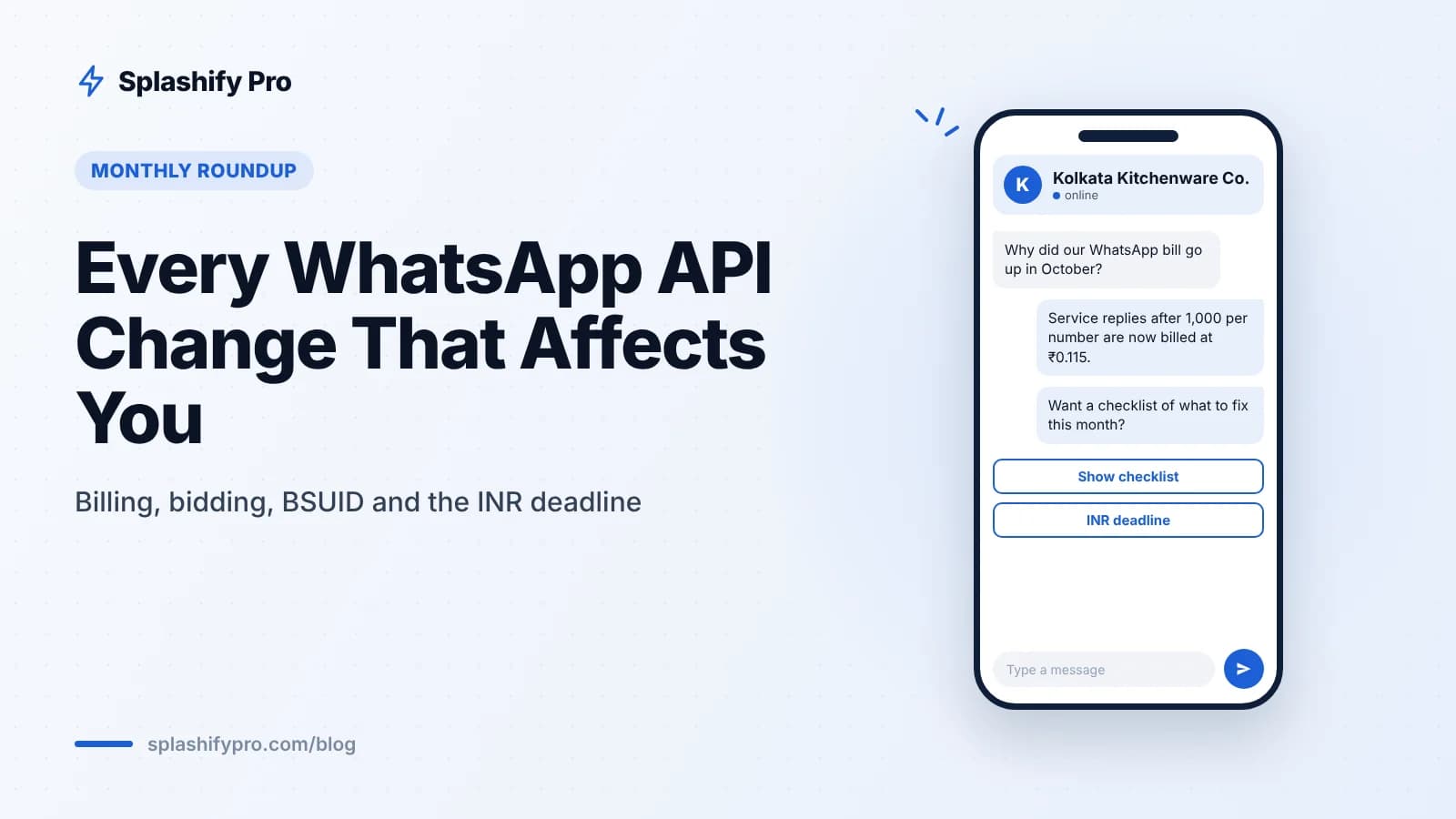
Since 1 October 2026, free-form replies you send inside the 24-hour customer service window are free only for the first 1,000 per business phone number per month. After that, each one is billed. In India the rate is ₹0.115 per message before 18% GST.
Two related changes matter just as much:
Utility templates inside an open window are billed again. They had been free since July 2025. Order confirmations sent while the chat is open now cost ₹0.115 each.
No payment method means no replies. Accounts without a payment method stop delivering replies once the free 1,000 are used.
Entry points from Click-to-WhatsApp ads and Facebook Page buttons still open a 72-hour free window, and the free WhatsApp Business app is not charged. For the full rate card, see our service message pricing guide for India.
What this means in practice
A busy support desk that sends 6,000 replies a month from one number now pays for 5,000 of them: about ₹575 plus GST. Not large, but it adds up across numbers, and it makes chatbot loops that send five messages where one would do a real cost.
2. Max price for marketing messages: open beta
Meta now lets you set a maximum price per delivered marketing message, at the template level. It started as a limited beta on 15 May 2026, moved to open beta in October, and is planned to become mandatory in eligible countries in Q2 2027.
You set it as bid_amount inside optimization_spec with the strategy LOWEST_COST_WITH_BID_CAP. The older bid_spec field stopped being accepted on 31 July 2026. Two catches: you cannot add a max price to an existing template, and max-price templates only send through the Marketing Messages API. Send one through the Cloud API and it fails with error 131061.
We explain the paise maths and a test plan in our max price guide.
3. Usernames and business-scoped user IDs
From April 2026, webhooks carry a business-scoped user ID (BSUID) alongside, and sometimes instead of, the phone number. Username reservations opened on 29 June 2026 and usernames started rolling out in waves from 7 July.
India is a special case. On 1 July 2026, MeitY asked Meta to hold usernames in India until consultations finish. The BSUID change is still global, so your webhooks and CRM need to handle it even if Indian customers cannot pick usernames yet. Our usernames and BSUID guide has the field table and a developer checklist.
4. Meta Business Agent: now billed by tokens
Meta's own AI agent for WhatsApp and Messenger expanded to businesses of all sizes globally on 3 June 2026. It can answer questions, recommend products, book appointments, qualify leads and hand off to humans.
From 1 August 2026 it is billed at $2 per million tokens (about ₹189). A typical message runs 20,000 to 25,000 tokens, which works out to roughly 4 to 5 US cents per message. It is billed even inside the free entry-point window. Smaller businesses can access it through some WhatsApp Business Premium tiers.
Compare that with your own chatbot or AI agent before switching. Our WhatsApp AI agents guide covers the options.
5. INR billing deadline: 31 December 2026
INR billing for WhatsApp launched on 1 January 2026. If your WABA is billed by Meta in India in any currency other than INR, you must migrate by 31 December 2026. If you do not, message delivery stops from 1 January 2027. The steps are in our INR billing migration guide.
Also note: 1 January 2027 is the next date on which Meta can change rates. Budget for Q1 2027 with that in mind.
6. Status ads, scheduled messages and Web calling
Ads in Status and promoted Channels: global rollout was confirmed in February 2026. Status ads can open a chat with the business, so plan for that inbound traffic.
Scheduled messages: entered beta on WhatsApp Android and iOS in February 2026.
Audio and video calling on WhatsApp Web: added on 28 July 2026.
7. Muse: AI agents that contact businesses
On 8 September 2026 Meta launched Muse in the US, a consumer AI agent that researches, books and contacts businesses for users. It is not in India yet, but it is a signal: some of your future inbound chats may come from an assistant acting for a customer. Clear catalogues, prices and booking flows will matter more.
What to do this month
Check your October invoice. Count service messages per number and see how many went past the free 1,000.
Trim bot replies. Merge multi-message bot steps into one message or an interactive list.
Confirm your billing currency. If it is not INR, start the migration now, not in the last week of December.
Ask developers about BSUID. Make phone fields nullable and store the user ID.
Plan Black Friday sends. Decide whether to test a max-price template. Our Black Friday playbook has the calendar.
Frequently asked questions
Are WhatsApp service messages still free in India?
The first 1,000 per business phone number per month are free. After that, each is billed at ₹0.115 plus GST from 1 October 2026.
Is max price mandatory now?
No. It is in open beta from October 2026 and planned to become mandatory in eligible countries in Q2 2027.
Do usernames affect Indian customers today?
Usernames are on hold in India after MeitY's request, but BSUIDs are already in webhooks globally, so your systems should handle them now.
What happens if I miss the INR deadline?
Non-INR WABAs billed by Meta in India that have not migrated will stop delivering messages from 1 January 2027.
The bottom line
Most of 2026's changes are about cost control and identity: pay attention to service message volume, test bid caps carefully, make your systems BSUID-ready and get to INR billing before year-end. Splashify Pro passes Meta's charges through at Meta's rate card, does not charge for failed messages, and plans start from ₹999/month + GST. Start your 7-day free trial, no credit card needed, or book a demo to review your setup with our team.
- #whatsapp api changes 2026
- #whatsapp bsuid
- #whatsapp business updates
- #whatsapp inr billing
- #whatsapp pricing india