For a decade, "automation" on WhatsApp meant a chatbot: tap a button, get a scripted reply, and hope your question fits the menu. In 2026, that era is ending. AI agents — systems that understand what a customer means, remember the conversation, and actually do things — are replacing rule-based bots. Meta has even launched its own WhatsApp AI agent that books appointments and closes sales without a human. Here's what that shift means for your business.
From chatbots to AI agents: the 2026 shift
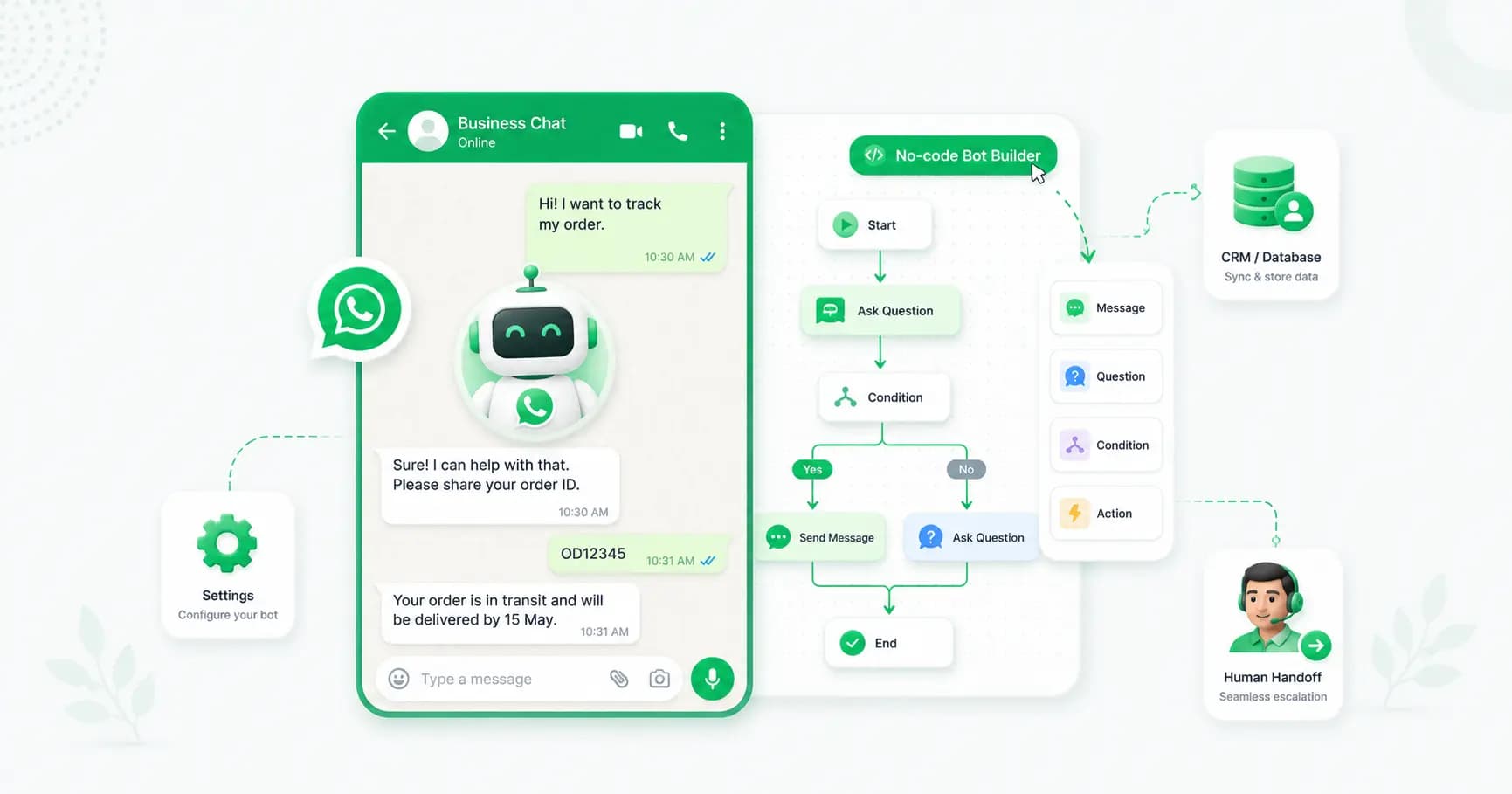
Customer automation has moved through three stages. First came rule-based chatbots — decision trees and if-then logic. Then generative AI assistants that could answer open questions. Now we've reached agentic AI: systems that don't just respond, but reason through a goal and take action, with limited human oversight.
The difference is fundamental. A chatbot follows a script. An AI agent follows a goal — it interprets intent, decides the next best step, pulls information from your connected tools, and moves a task toward completion. As the saying in the industry goes: chatbots follow rules; AI agents pursue outcomes.
What is a WhatsApp AI agent?
A WhatsApp AI agent is an AI-powered system that holds natural conversations on WhatsApp and completes tasks on your behalf. Unlike a basic chatbot, it's built on four capabilities:
- Understanding intent — using a large language model, it grasps what a customer means regardless of how they phrase it. "How much for the blue one?", "price of the blue shirt?" and "cost of that blue item?" all resolve to the same question.
- Memory and context — it remembers earlier messages in a conversation (and often across visits), so a customer can say "is that still available?" and the agent knows what "that" is.
- Access to tools — it connects to your systems (CRM, catalogue, order database, calendar) to look things up and take action.
- Reasoning — it evaluates options and decides the next step, rather than following a fixed path.
AI agent vs chatbot: the key differences
Features | Rule-based chatbot | AI agent |
|---|---|---|
Logic | If-then, decision trees | LLM-based reasoning |
Understanding | Exact keywords/buttons | Natural language, any phrasing |
Memory | None between messages | Retains context |
Tasks | Single scripted response | Multi-step task completion |
Actions | Displays pre-set info | Checks data, takes actions |
Scaling | Linear — more questions, more configuration | Exponential — more knowledge, more resolved |
A rule-based bot needs someone to program every possible conversation path. An AI agent needs a knowledge base and a good prompt — so it scales with your information, not your configuration effort.
What a WhatsApp AI agent can actually do
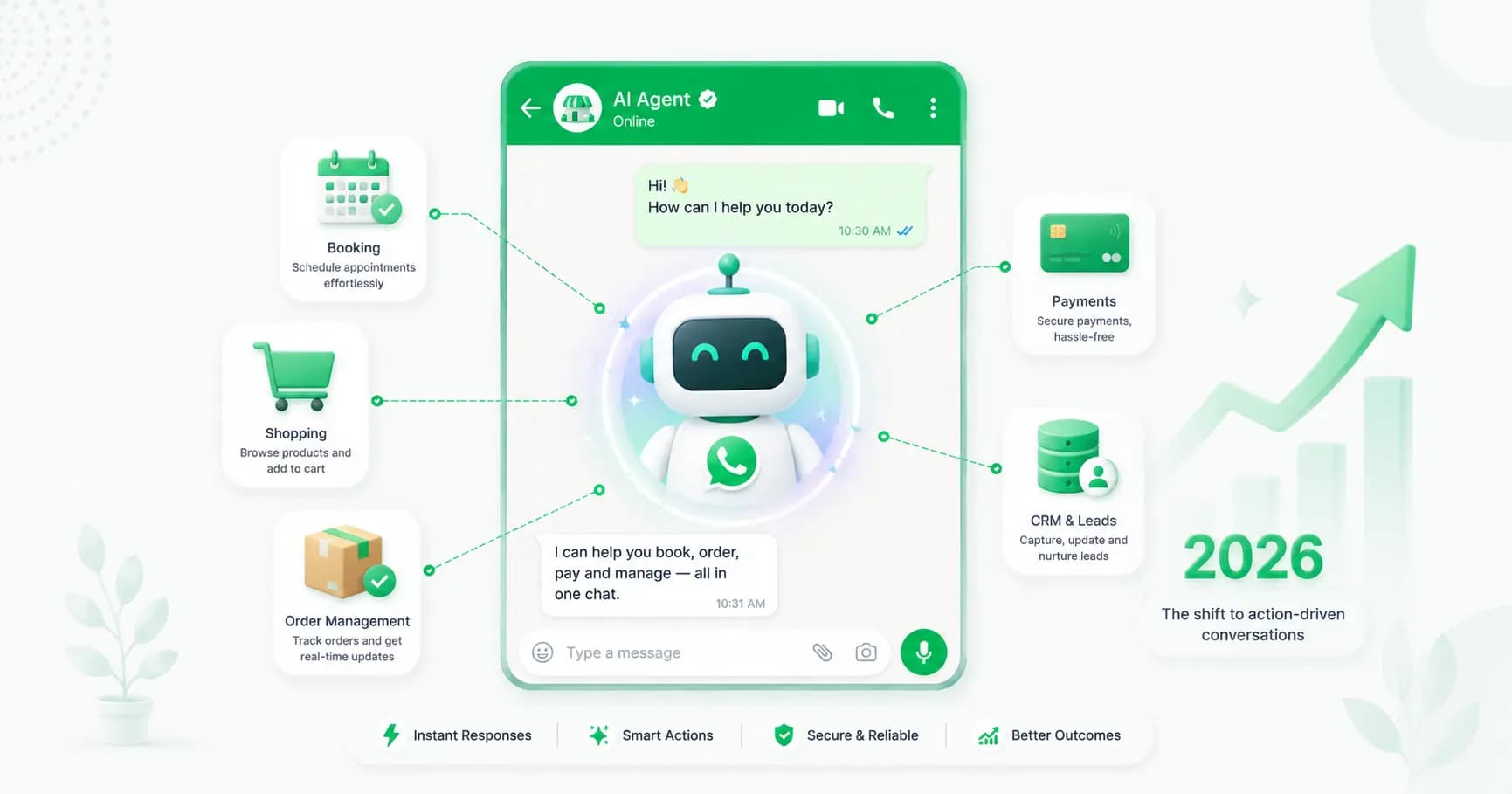
This is where agents leave chatbots behind — they take real actions inside the conversation:
- Check live data — look up stock, order status or account details in real time.
- Complete transactions — recommend products, handle objections, generate a payment link and guide the customer to checkout.
- Book appointments — check real availability, propose times, and confirm — no back-and-forth.
- Recover carts and re-engage — act as a personal shopping assistant that nudges buyers toward purchase.
- Resolve support autonomously — answer complex, multi-part questions grounded in your help content, and escalate only when needed.
Meta's own new WhatsApp agent illustrates the leap: a customer asks to schedule a service call, and the agent checks availability, proposes times and confirms the booking; a prospect asks about pricing, and it presents options, handles objections and processes the sale — with no handoff to a human.
Why 2026 is the inflection point
Three signals show this is real, not hype:
- Meta is all-in. Its AI tools on WhatsApp and Messenger now handle around 10 million business conversations a week — a 10× jump since January 2026 — and its new agent takes actions, not just answers.
- The analysts agree. Gartner projects that 40% of enterprise applications will include task-specific AI agents by the end of 2026 (up from under 5%), and that by 2029 agentic AI will autonomously resolve 80% of common customer service issues. McKinsey estimates generative AI could add $2.6–4.4 trillion to the global economy each year.
- The exploration phase is over. By 2025, 85% of customer service leaders had piloted conversational generative AI, per Gartner. 2026 is the year of scaled deployment — which means the businesses moving now get a head start their competitors won't easily close.
The ROI of WhatsApp AI agents
The numbers from businesses already running agents are compelling: autonomous resolution rates of 55–80%, response times measured in seconds instead of hours, and operational cost reductions of around 30–45%. In one McKinsey case study of 5,000 support agents, generative AI drove a 14% increase in queries resolved per hour and a 9% cut in handling time. Businesses across e-commerce, food delivery and services have reported large jumps in sales and repeat purchase rates after deploying AI agents on WhatsApp.
WhatsApp AI agent use cases
- E-commerce — product discovery, stock checks, order tracking, returns, cart recovery and in-chat checkout.
- Customer support — 24/7 first-line resolution, troubleshooting, and billing or renewal queries.
- Sales — lead qualification, objection handling, and closing — routing hot leads to a human when it counts.
- Appointment booking — for clinics, salons, services and trades, checking real availability and confirming.
- Onboarding — guiding new users step by step.
AI agents don't replace your team
An AI agent isn't there to remove your people — it's there to handle the repetitive, high-volume work so they don't have to. Agents resolve routine and mid-complexity queries and escalate the genuinely complex ones, with full context, to a human in your shared inbox. Gartner notes that most service leaders plan to reskill agents into higher-value roles rather than cut teams. The winning setup pairs AI with humans, not one instead of the other.
The one thing that separates good agents from bad: grounding
Here's the make-or-break detail. An AI agent is only as reliable as the information it's built on. A well-built agent is grounded in your business content — your catalogue, policies, pricing and help docs — so it answers from your data, not the model's imagination, and says "let me connect you to a colleague" when it doesn't know. A thin "wrapper around ChatGPT" that skips this grounding will confidently invent prices and promises — which is worse than no bot at all. When you evaluate AI agents, grounding is the feature that matters most.
A note on compliance: since January 2026, Meta requires AI on WhatsApp to be task-oriented — a business agent that helps with support, sales and bookings, not an open-ended "ask me anything" assistant. Purpose-built AI agents fit this perfectly.
How to get started
Want the practical, step-by-step build? See our guide on how to build a WhatsApp chatbot. In short: get on the WhatsApp Business API, ground an agent in your business content, connect your tools, set up human handoff, test, and launch.
Splashify Pro makes this straightforward — it includes AI agents on its Growth plan (not as a pricey add-on), grounded in your own content, with tool and CRM integrations so the agent can take real actions, seamless handoff to human agents, and multilingual support. You can even extend it to voice with a 24/7 AI voice receptionist. It's an AI agent that works across WhatsApp, Instagram and more, from one platform.
Frequently asked questions
What is a WhatsApp AI agent?
It's an AI-powered system on WhatsApp that understands customer intent, remembers conversation context, connects to your business tools, and completes tasks — like answering complex questions, tracking orders, booking appointments and closing sales — rather than following a fixed script like a basic chatbot.
What's the difference between an AI agent and a chatbot on WhatsApp?
A chatbot follows predefined if-then flows and needs exact keywords, with no memory between messages. An AI agent uses a large language model to understand natural language, retain context, reason through requests, and take multi-step actions using your connected data. Chatbots follow scripts; AI agents pursue goals.
Can a WhatsApp AI agent take real actions, not just answer questions?
Yes. With integrations, an AI agent can check stock, look up order status, generate payment links, process transactions, and book appointments inside the conversation — Meta's own WhatsApp agent, for example, schedules service calls and closes sales without a human handoff.
Do AI agents replace human support teams?
No. They handle the repetitive and mid-complexity queries (typically resolving 55–80% autonomously) and escalate complex ones to a human with full context. Most companies reskill their teams into higher-value roles rather than reducing them.
Are AI agents allowed on WhatsApp?
Yes, but they must be task-oriented. Since January 2026, Meta bans general-purpose "ask me anything" AI chatbots on WhatsApp — purpose-built business agents for support, sales and bookings are fully compliant.
How accurate are WhatsApp AI agents?
That depends on grounding. An agent grounded in your business content (catalogue, policies, help docs) answers accurately from your data and escalates when unsure. A generic bot that isn't grounded can hallucinate wrong answers, so grounding is the most important thing to look for.
How do I add an AI agent to my WhatsApp?
Connect to the WhatsApp Business API through a platform, ground the agent in your business content, integrate your tools (CRM, catalogue, calendar), set up human handoff, and go live. Platforms like Splashify Pro include AI agents so you don't have to build the infrastructure yourself.
The bottom line
AI agents are turning WhatsApp from a channel where you reply to customers into one where an intelligent system serves them — understanding intent, remembering context, and completing tasks around the clock. 2026 is the year this goes mainstream, backed by Meta's own agent and every major analyst. The businesses that deploy grounded, task-focused AI agents now will be running leaner and responding faster while competitors are still mapping decision trees.
Deploy an AI agent on WhatsApp with Splashify Pro → — grounded in your business, connected to your tools, with human handoff built in. Included on the Growth plan. Start free for 14 days.
- #agentic ai whatsapp
- #ai agent for whatsapp
- #ai agents on whatsapp
- #whatsapp ai agent
- #whatsapp ai automation
- #whatsapp ai chatbot