Every missed call is a customer who chose to try someone else. For a clinic, a property developer or a busy D2C brand, the phone still rings at 10 pm, on Sunday and during lunch, and most teams cannot staff it around the clock. A voice AI agent picks up every call, talks to the caller in Hindi, English or the language they prefer, and gets the job done or hands over to a person.
What is a voice AI agent?
A voice AI agent is software that answers phone calls and holds a natural spoken conversation. It listens to the caller, understands what they want, looks up the information it needs and replies in a human-sounding voice. Unlike an old IVR ("press 1 for sales, press 2 for support"), the caller simply speaks: "Mera order kab aayega?" or "Do you have a slot with the dentist tomorrow evening?"
Under the hood, most voice agents combine three pieces:
Speech-to-text that turns the caller's words into text, including mixed Hindi-English speech that is common in India.
A language model that decides what to say or do next, guided by your instructions, FAQs and business data.
Text-to-speech that speaks the reply in a natural voice and the caller's language.
On Splashify Pro, the Voice AI agent answers calls in Hindi, English and more, and sits alongside your WhatsApp inbox, chat AI agents and CRM, so a call and a WhatsApp conversation with the same customer are not two separate worlds.
Why Indian businesses are adding voice now
WhatsApp and chat have taken over a large share of customer conversations, but many Indian customers still prefer to call, especially for anything urgent, high-value or confusing. Older customers, first-time buyers and people in smaller towns often pick up the phone first. A voice agent lets you serve them the same way you already serve chat customers: instantly, at any hour and in their language.
24/7 coverage without night shifts or overflow call centres.
Language flexibility without hiring separate teams for every language.
No hold music at peak times, such as sale days or the first hour after a property ad goes live.
Consistent answers on pricing, timings and policies, every time.
Use cases that work well
Clinics and diagnostic centres
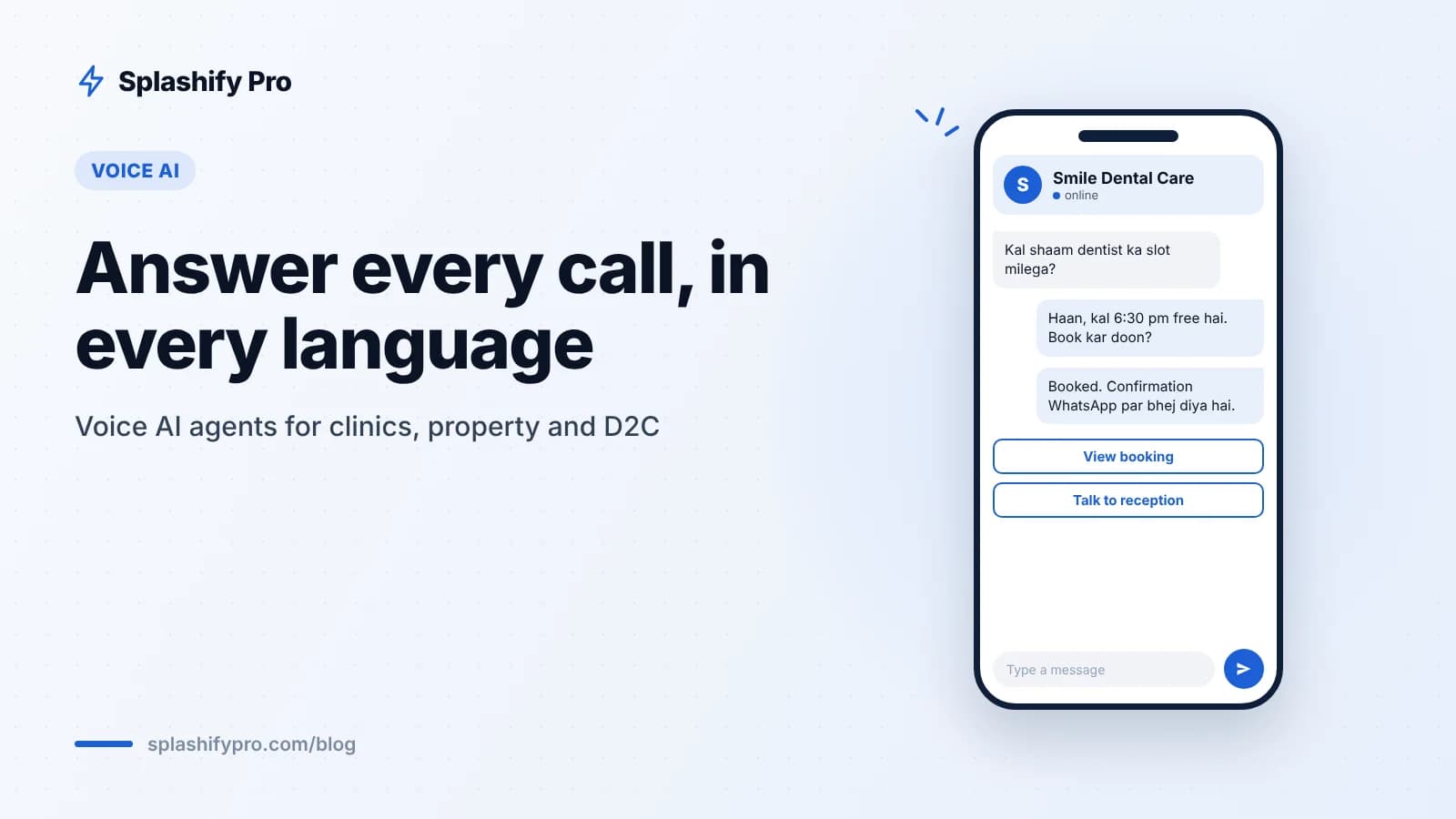
Picture a hypothetical dental clinic in Kolkata. Most calls are the same handful of questions: timings, fees, which doctor is in today and "can I book for tomorrow?" A voice agent can answer those, offer available slots, take the patient's name and preferred time, and then send a WhatsApp confirmation with the address and a map link. Anything clinical, such as symptoms or medication questions, is handed straight to the front desk or doctor. See our WhatsApp for healthcare guide for the follow-up side.
Real estate
Property ads generate bursts of calls, often in the evening when sales teams have gone home. A voice agent can qualify each caller (budget, location, BHK, ready-to-move or under construction, timeline), answer basic project questions and offer a site-visit slot. Qualified leads land in your CRM with tags, and your sales team calls back the hottest ones first. Pair this with WhatsApp for real estate to send brochures and floor plans after the call.
D2C order status and support
"Where is my order?" is the most common support question for most online brands. A voice agent connected to your order data can ask for the order number or registered phone number, read out the status and expected delivery date, and offer to send the tracking link on WhatsApp. It can also take simple requests such as address corrections or return requests, and pass anything complex to a human.
Other good fits
Coaching institutes answering fee and batch-timing questions.
Restaurants taking table reservations.
Service businesses (AC repair, pest control, salons) booking appointments.
After-hours overflow for any business with a support line.
How it works, step by step
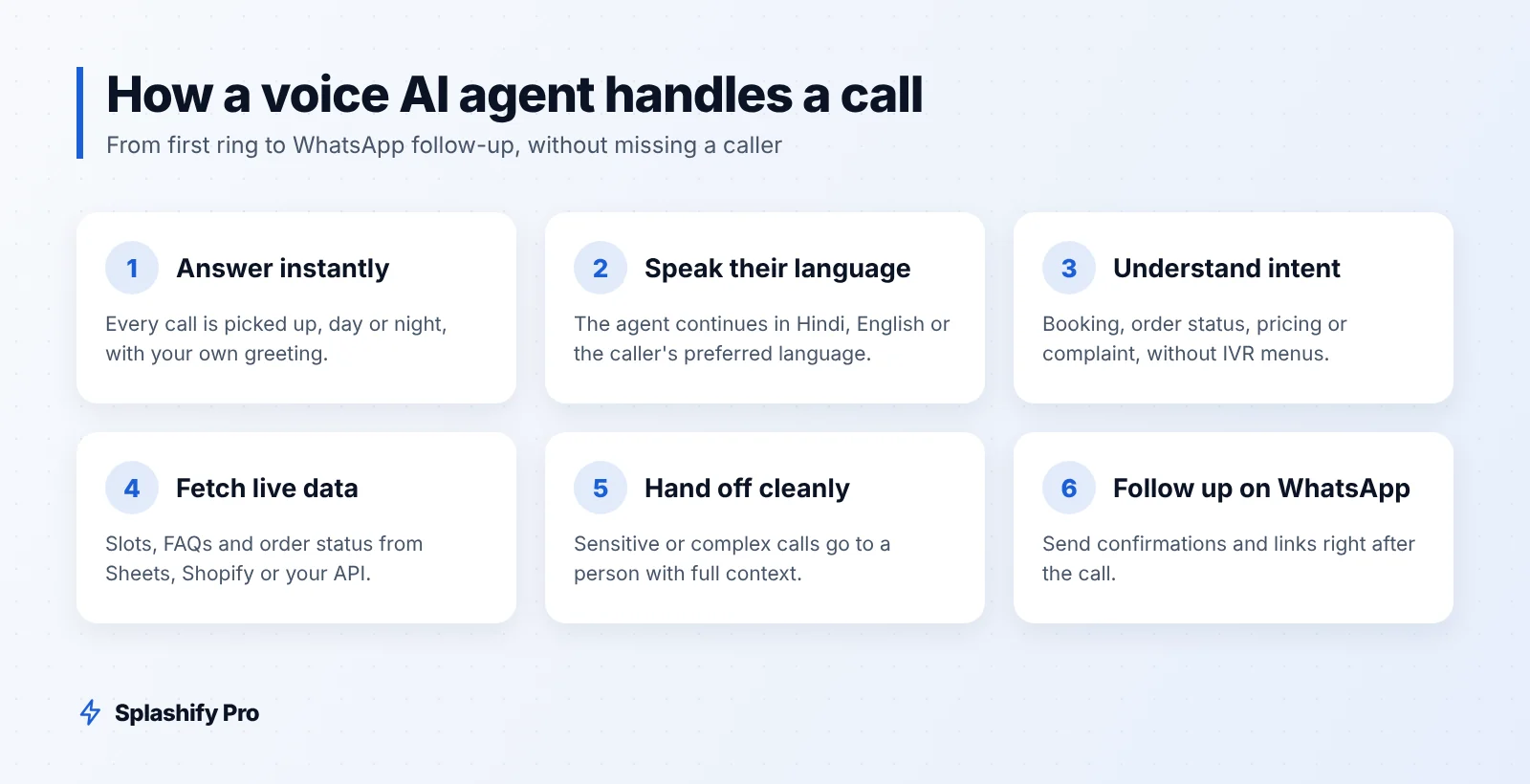
The call comes in on your business number and the agent answers with your greeting.
Language is set from the caller's first words or a quick choice, and the agent continues in that language.
Intent is understood: booking, order status, pricing, complaint or something else.
Data is fetched from the sources you connect (your FAQs, a Google Sheet, Shopify order data or your own system through webhooks and the API).
The task is completed: a slot is offered, a lead is captured or a status is shared.
Follow-up goes out on WhatsApp, for example a booking confirmation or tracking link, using an approved utility template.
The record is saved in the CRM with notes and tags so your team sees what happened.
Designing a good human handoff
A voice agent should not trap callers. The best setups make it easy to reach a person, and make sure that person does not have to start from scratch.
Clear triggers: the caller asks for a human, sounds upset, repeats themselves, or raises something sensitive (medical, legal, payment disputes).
Warm transfer during working hours: the call goes to an available team member along with a short summary.
Callback after hours: the agent confirms a callback time and creates a task in your inbox or CRM.
Context carries over: name, number, intent and what was already said are visible to the agent who picks it up.
If your team already works from a shared team inbox, voice handoffs can land in the same place as WhatsApp chats.
Voice agent vs IVR vs human-only
Factor | Traditional IVR | Human-only team | Voice AI agent |
|---|---|---|---|
Availability | 24/7, but limited | Working hours | 24/7 |
Caller experience | Menus and key presses | Natural conversation | Natural conversation |
Languages | Pre-recorded options | Depends on staff | Hindi, English and more |
Peak handling | Queues | Queues or missed calls | Handles calls in parallel |
Complex or emotional issues | Poor | Best | Hands off to a human |
What to measure
Track a small set of numbers from the first week and review call recordings or transcripts regularly.
Answer rate: share of calls answered. This should be close to all of them.
Resolution (containment) rate: calls fully handled without a human.
Handoff rate and reasons: why callers needed a person. Each common reason is a gap to fix in your instructions or data.
Task conversion: bookings made, leads qualified, site visits scheduled.
Average call duration: shorter is usually better for simple tasks like order status.
Caller feedback: a one-question WhatsApp survey after the call works well.
Getting started
List your top 10 call reasons from the last month.
Write clear answers and rules for each, including when to hand off.
Connect the data the agent needs (FAQs, slots, order status).
Start with after-hours calls, then expand once you trust the results.
Set up WhatsApp follow-up templates for confirmations and links.
If you are also automating chat, our guide to WhatsApp AI agents covers how the chat and voice sides work together. And as AI assistants begin to contact businesses on behalf of shoppers, read how to prepare for agentic commerce.
Frequently asked questions
Can a voice AI agent understand Hinglish?
Modern speech recognition handles mixed Hindi-English speech reasonably well, which is how many Indian callers speak. Test with real calls from your customers and refine the agent's instructions where it struggles.
Will customers know they are talking to AI?
We recommend saying so in the greeting. Being upfront builds trust, and callers who want a person can ask for one at any time.
Does it replace my support team?
No. It takes the repetitive calls and after-hours load so your team can focus on complex, high-value and sensitive conversations.
Can it send WhatsApp messages after a call?
Yes. A common pattern is to send a booking confirmation, tracking link or brochure on WhatsApp right after the call using an approved template.
The bottom line
A voice AI agent makes sure no call goes unanswered, in the language your customer speaks, at any hour. Start with your most common call reasons, design a clean handoff and measure what gets resolved. Splashify Pro brings the Voice AI agent, WhatsApp API, AI chat agents and CRM together in one place, with plans from ₹999/month + GST. Start your 7-day free trial (no credit card needed) or book a demo to hear it on your own use case.
- #ai call answering
- #ai receptionist india
- #hindi voice bot
- #inbound call automation
- #voice ai agent