
An OTP that arrives late is an OTP that fails. Users abandon sign-ups, payments stall and support tickets pile up. In 2026, Indian businesses have three serious channels for one-time passcodes, WhatsApp, SMS and RCS, and the best setups no longer pick one. They combine them in a fallback chain that balances delivery, cost and security.
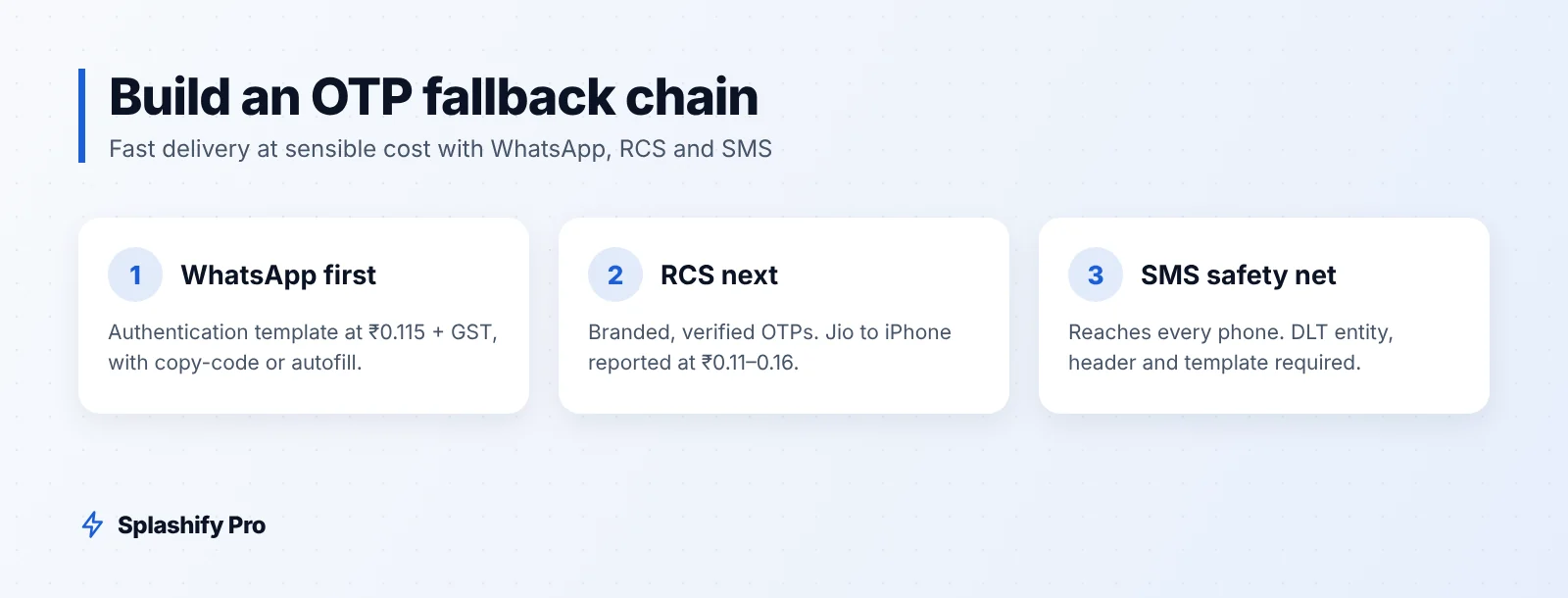
The three OTP channels at a glance
Factor | WhatsApp authentication | SMS | RCS |
|---|---|---|---|
Price (India) | ₹0.115 per delivered message + GST (from 1 Oct 2026) | Varies by provider and route | Jio OTP to iPhones reported at ₹0.11–0.16 per message (Sep 2026) |
Reach | Users with WhatsApp installed | Every mobile number | RCS-capable phones on supporting networks |
Registration | WhatsApp Business API + approved authentication template | TRAI DLT: entity, header and template | RCS agent registration and verification |
Delivery feedback | Sent, delivered and read webhooks | Delivery reports (depends on operator) | Delivery and read receipts |
Autofill | Copy-code, one-tap and zero-tap options (Android) | OS-level SMS autofill | Depends on device and app |
Branding | Business name, logo, verified profile options | Sender ID only | Brand name, logo, verified sender |
WhatsApp authentication templates
WhatsApp has become a primary OTP channel for many Indian apps because almost every smartphone user has it, and the experience is clean.
Cost: ₹0.115 per delivered authentication message in India from 1 October 2026, before 18% GST. Failed messages are not charged on Splashify Pro.
Format: authentication templates use Meta's preset wording, with optional "do not share this code" security text and an expiry note. You cannot add marketing text or links.
Buttons: copy code works everywhere; one-tap and zero-tap autofill are available for Android apps that integrate them.
Limitations: the user must have WhatsApp on that number, and phones without data connectivity will not receive it.
Setup details are in our WhatsApp OTP authentication guide.
SMS OTP and DLT
SMS is still the universal fallback. It works on every phone, including feature phones and devices without mobile data.
DLT is mandatory. Under TRAI rules, you must register your business entity, sender headers and content templates on a DLT platform before sending commercial SMS. OTPs go on a transactional or service route.
Template matching: the message must match the registered template exactly, with variables only where you defined them. A mismatch means the SMS is blocked.
Links: TRAI requires URLs in SMS to be whitelisted. Keep OTP messages free of links anyway.
Cost: SMS pricing varies widely by provider, route and volume, so compare quotes rather than relying on a headline rate.
RCS OTP
RCS is the newest option and is growing quickly in India. RCS interactions in India grew 108% from H1 2025 to H1 2026, according to Infobip, and finance and fintech account for roughly four out of five RCS interactions. That makes sense: banks and fintechs send a lot of OTPs and alerts.
iPhone reach on Jio: the Jio and Apple partnership brought RCS to iPhones on Jio (more in our RCS on iPhone guide). Reported Jio rates for business RCS to iPhone users from September 2026 are ₹0.11–0.16 per OTP message, up from ₹0.08–0.10.
Branded and verified: messages show your brand name and logo, which helps users spot fakes.
Coverage is uneven: RCS depends on device, operator and settings, so it always needs a fallback.
For more on the channel, read RCS business messaging in India.
Designing a fallback chain
The goal is simple: get the code to the user within seconds, at the lowest sensible cost, without sending duplicates they cannot tell apart.
Chain 1: WhatsApp first, SMS fallback
Send the WhatsApp authentication template.
Listen for the delivered status on your webhook.
If there is no delivered status within a short timeout (many teams use 10 to 20 seconds), send the same code by SMS.
Show a "Resend via SMS" option on screen as a manual backup.
Chain 2: RCS first, SMS fallback
Useful for banking and fintech audiences, and for reaching iPhone users on Jio with a branded message. If RCS capability is not available for a number, go straight to SMS.
Chain 3: WhatsApp, then RCS, then SMS
For high-volume apps that want to minimise SMS use. Keep timeouts short so the total wait stays reasonable.
Rules for any chain
Send the same code on every channel, so whichever arrives first works.
Tell the user on screen where the code was sent: "We sent a code on WhatsApp to +91 98xxx xxx10."
Let the user choose a channel on retry.
Track delivery rate, time to deliver and verification rate per channel, and adjust your order based on your own data.
Security checklist
Short expiry: 5 to 10 minutes is common. Show the expiry in the message.
Attempt limits: lock verification after a few wrong tries and rate-limit resend requests per number and per IP.
Never include links in an OTP message. Phishing messages often do.
Add "do not share" text. WhatsApp's authentication template offers a built-in security recommendation.
Store codes hashed and invalidate them after use.
Watch for SIM-swap and pumping fraud: sudden OTP spikes to unusual number ranges or countries are a red flag.
Use verified senders where possible (verified business profile on WhatsApp, verified RCS agent, registered DLT header).
Cost example
A hypothetical Mumbai fintech app sends 1,00,000 OTPs a month. On WhatsApp authentication alone, that is 1,00,000 × ₹0.115 = ₹11,500, plus 18% GST. If 10% fall back to SMS, add your SMS provider's rate for 10,000 messages. Compare that blended cost with your current SMS-only bill, and remember that delivery speed and success rate matter as much as unit price. Our RCS vs WhatsApp vs SMS comparison covers the broader trade-offs.
Frequently asked questions
Which OTP channel is cheapest in India?
It depends on your SMS contract and audience. WhatsApp authentication is ₹0.115 per delivered message before GST, and Jio RCS OTP to iPhones has been reported at ₹0.11–0.16. Get SMS quotes from your provider to compare.
Do I still need DLT if I use WhatsApp for OTPs?
Only for SMS. If SMS is in your fallback chain, which we recommend, your DLT registration and templates must be in place.
Can I send OTPs on WhatsApp to users who have not messaged me?
Yes, using an approved authentication template, as long as the user has requested the code in your app or website.
Is RCS available to all Indian users?
No. It depends on the phone, operator and settings, which is why RCS should always have an SMS fallback.
The bottom line
There is no single best OTP channel in India in 2026. WhatsApp gives a clean, branded experience at ₹0.115, RCS adds verified branding and iPhone reach on Jio, and SMS remains the universal safety net. Build a fallback chain, send the same code everywhere, and measure delivery by channel. Splashify Pro offers WhatsApp, RCS and SMS from one platform with a public API and SDKs for Node, Python and PHP, with plans from ₹999/month + GST. Start your 7-day free trial or book a demo to plan your OTP setup.
- #authentication messages
- #otp fallback
- #otp india
- #rcs otp
- #sms otp dlt
- #whatsapp otp