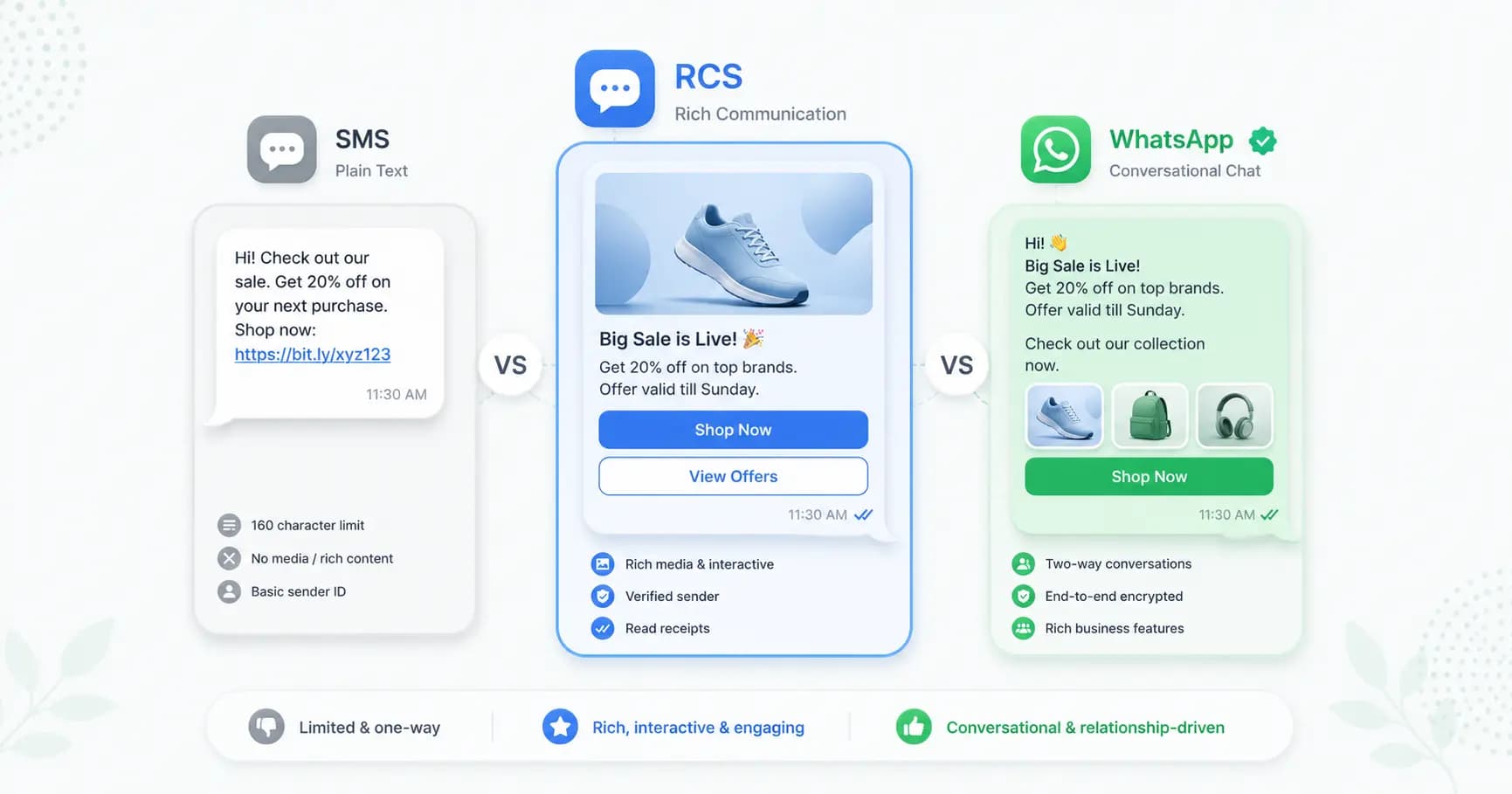
Every business that messages customers eventually faces the same question: SMS, WhatsApp, or RCS — which one should you actually use? Each has real strengths, and the right answer often isn't "pick one" but "use the right one for each job."
This guide compares RCS, WhatsApp and SMS head-to-head on features, cost, reach and use cases for India in 2026 — so you can choose the right channel (or combination) for your business.
The short answer
If you're short on time, here's the summary:
- SMS wins on reach — it works on every phone, including feature phones with no internet. Best for OTPs and critical alerts.
- WhatsApp wins on conversation and engagement — it's cross-platform and built for two-way chats, support and chatbots. Best for relationships and support.
- RCS wins on rich, branded messaging — images, buttons and verified branding inside the native Android inbox, with no app download. Best for high-impact campaigns and transactional messages to Android users.
The smartest businesses use more than one. Read on for the detail.
Factor | SMS | RCS | |
|---|---|---|---|
Message type | Plain text | Rich media + buttons | Rich media + chat |
Verified branding | Sender ID only | Yes (verified) | Yes (green tick) |
Two-way conversation | Limited | Yes | Yes (best) |
Needs an app | No | No (native inbox) | Yes |
Opt-in | DLT consent | Low friction | Explicit opt-in |
Platforms | All phones | Android + iPhone (iOS 18+) | Android + iPhone |
Reach in India | 100% of phones | 450M+ Android devices | Opted-in users |
Typical India cost/msg | Lowest | ~₹0.18–₹0.30 | ~₹0.86 (marketing) |
Best for | OTPs, critical alerts | Branded campaigns | Support & conversations |
Rates and support vary by operator and provider; figures current as of 2026.
The three channels at a glance
SMS (Short Message Service) is the original text channel — plain text, up to 160 characters, delivered over carrier networks to every phone. In India it's regulated by the TRAI DLT framework and is the cheapest option.
WhatsApp is the world's most popular messaging app, used by 535M+ people in India. Through the WhatsApp Business API, businesses send template messages and have two-way conversations — but only with users who have the app and have opted in.
RCS (Rich Communication Services) is the modern upgrade to SMS — rich media, interactive buttons, carousels and verified branding, delivered inside the native Android messaging app with no separate app required. (New to RCS? See our guide on what RCS messaging is.)
RCS vs SMS
RCS and SMS arrive in the same inbox, but they're worlds apart:
- Content: SMS is plain text; RCS supports images, video, buttons and carousels.
- Branding: SMS shows a sender ID; RCS shows your verified business name, logo and a checkmark.
- Engagement: RCS typically delivers far higher click-through — often around 5× SMS.
- Feedback: SMS offers basic delivery info; RCS adds read receipts and analytics.
- Reach: SMS reaches 100% of phones; RCS needs an RCS-capable smartphone (with SMS fallback covering the rest).
- Cost: SMS is cheaper per message; RCS costs more but usually returns far more engagement.
Verdict: RCS is SMS done right — richer, branded and more engaging — while keeping SMS as a fallback for devices that can't receive it.
RCS vs WhatsApp
Both offer rich, interactive messaging, but they differ in reach and how customers opt in:
- Platform: RCS is strongest on Android (with growing iPhone support via iOS 18+); WhatsApp is fully cross-platform.
- App and opt-in: RCS works in the native inbox with low opt-in friction; WhatsApp requires the app and explicit opt-in.
- Conversation: WhatsApp is built for rich two-way conversations, support and chatbots; RCS shines for branded, interactive campaign and transactional messages.
- Reach in India: RCS reaches 450M+ Android devices without an app; WhatsApp reaches its large opted-in user base across both platforms.
- Cost: RCS is often cheaper per message than WhatsApp marketing messages in India.
Verdict: WhatsApp is the better conversational and cross-platform channel; RCS is the better branded-broadcast channel for Android — and many businesses use both.
WhatsApp vs SMS
- Richness: WhatsApp supports media, buttons and two-way chat; SMS is plain text only.
- Reach: SMS reaches every phone; WhatsApp reaches app users who've opted in.
- Engagement: WhatsApp has far higher open and reply rates; SMS is one-way and easily ignored.
- Cost: SMS is cheaper per message, but WhatsApp's engagement often delivers better ROI.
- Use case: SMS for universal critical alerts; WhatsApp for conversations, support and richer marketing.
Verdict: WhatsApp wins for engagement and conversation; SMS wins only where universal reach to every device is essential.
Cost comparison (India, 2026)
Roughly, per message in India:
- SMS: the cheapest — a few paise per message.
- RCS: around ₹0.18–₹0.30 for basic and rich messages (rates vary by operator and aren't TRAI-regulated).
- WhatsApp: ~₹0.86 per marketing message, ~₹0.11–₹0.145 for utility/authentication, and free service replies within the 24-hour window. (Full breakdown in our WhatsApp Business API pricing guide.)
SMS is cheapest per send, but RCS and WhatsApp typically deliver far more engagement and conversions per rupee for the right use cases.
Reach comparison (India)
- SMS: ~100% of phones, including feature phones and no-internet users — unmatched for universal reach.
- RCS: 450M+ RCS-capable Android devices (Jio, Airtel and Vi all support it), with SMS fallback for the rest.
- WhatsApp: 535M+ users, but only those who have the app and have opted in to hear from you.
Which channel should you use?
Match the channel to the job:
- OTPs, payment alerts, critical notifications: SMS — guaranteed delivery to every device, including feature phones.
- Branded promotions, product showcases, offers (to Android users): RCS — rich, verified and high-converting.
- Customer support, two-way conversations, chatbots: WhatsApp — conversational and cross-platform.
- Order updates and transactional messages: RCS for rich branded updates on Android; WhatsApp utility templates for cross-platform reach.
- Reaching everyone, every time: combine — RCS with SMS fallback, plus WhatsApp for opted-in audiences.
Why use multiple channels together
The strongest messaging strategies don't pick one channel — they orchestrate several:
- SMS as the universal safety net for must-deliver alerts.
- RCS as the high-impact, branded channel for Android campaigns and transactional messages.
- WhatsApp as the conversational hub for support, engagement and richer two-way journeys.
Used together, you reach customers where each channel performs best — and you're not betting your entire customer communication on a single rail.
How Splashify Pro helps
Splashify Pro brings the two richest, highest-converting channels together in one platform: the WhatsApp Business API for conversational engagement, and RCS messaging as the modern, branded upgrade to traditional SMS. With RCS you send verified, interactive, rich messages — with SMS fallback handling delivery to non-RCS devices — while WhatsApp powers two-way support, broadcasts and chatbots. Instead of juggling separate tools, you run both channels (plus Instagram and email) from a single dashboard with one team inbox.
Frequently asked questions
What's the difference between RCS, WhatsApp and SMS?
SMS is plain text that reaches every phone. WhatsApp is a cross-platform messaging app for rich two-way conversations with opted-in users. RCS is the modern upgrade to SMS — rich, branded, interactive messages in the native Android inbox, with no app download. Each suits different jobs.
Is RCS better than WhatsApp?
Neither is universally "better" — RCS is stronger for branded, interactive broadcasts to Android users with low opt-in friction, while WhatsApp is stronger for two-way conversations, support and cross-platform reach. Many businesses use both.
Is RCS replacing SMS?
RCS is the successor to SMS, adding rich media, branding and interactivity. SMS isn't disappearing yet — it remains essential for universal reach and as RCS's fallback — but RCS is becoming the default for modern business messaging on Android.
Which is cheapest — RCS, WhatsApp or SMS?
SMS is the cheapest per message. RCS costs more (around ₹0.18–₹0.30 in India) but delivers higher engagement. WhatsApp marketing messages cost ~₹0.86 in India, with cheaper utility messages and free service replies.
Does RCS work on iPhone?
Yes. Apple added RCS support in iOS 18 (2024), and iOS 26.5 added end-to-end encryption for RCS chats between iPhone and Android. RCS support on iPhone depends on the carrier.
Which channel has the widest reach in India?
SMS reaches 100% of phones, including feature phones. RCS reaches 450M+ Android devices with SMS fallback. WhatsApp reaches its large opted-in user base across Android and iPhone.
Can I use RCS and WhatsApp together?
Yes — and you should. They serve different jobs: RCS for branded Android campaigns and transactional messages, WhatsApp for conversational support and engagement. A platform like Splashify Pro runs both from one place.
Which channel is best for OTPs?
SMS, because it reaches every device including feature phones and works without internet. RCS and WhatsApp can also send authentication messages, but SMS guarantees the widest delivery for critical codes.
The bottom line
There's no single winner in RCS vs WhatsApp vs SMS — each wins at a different job. SMS gives you universal reach, WhatsApp gives you conversation and engagement, and RCS gives you rich, branded messaging on Android without an app. The businesses that win use the right channel for each message, often combining them.
Run WhatsApp and RCS from one platform with Splashify Pro → — branded RCS campaigns plus conversational WhatsApp, in a single dashboard. Free for 14 days, or see pricing.
- #business messaging channels
- #rcs messaging
- #rcs vs sms
- #rcs vs whatsapp
- #rcs vs whatsapp vs sms
- #whatsapp vs sms