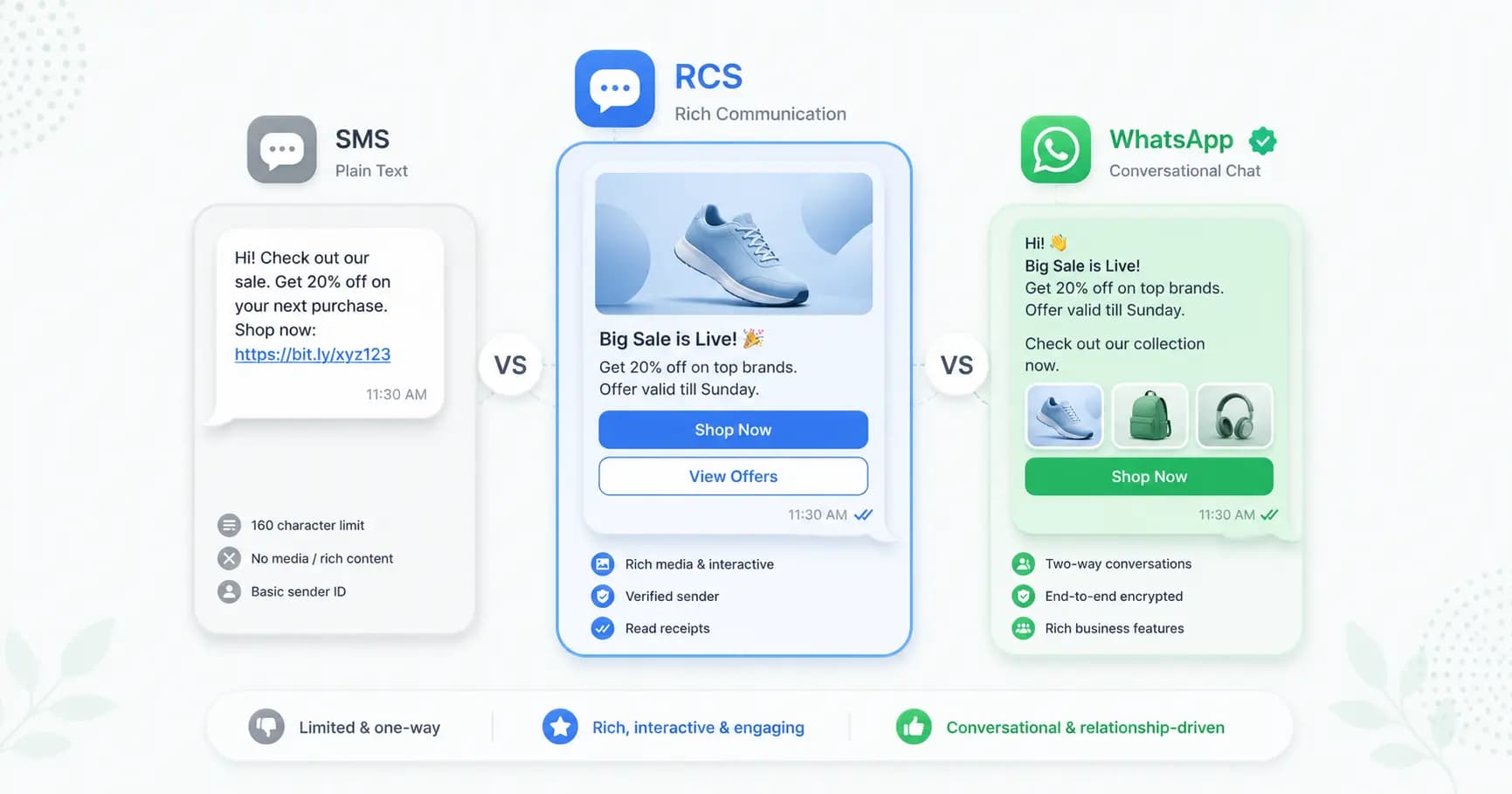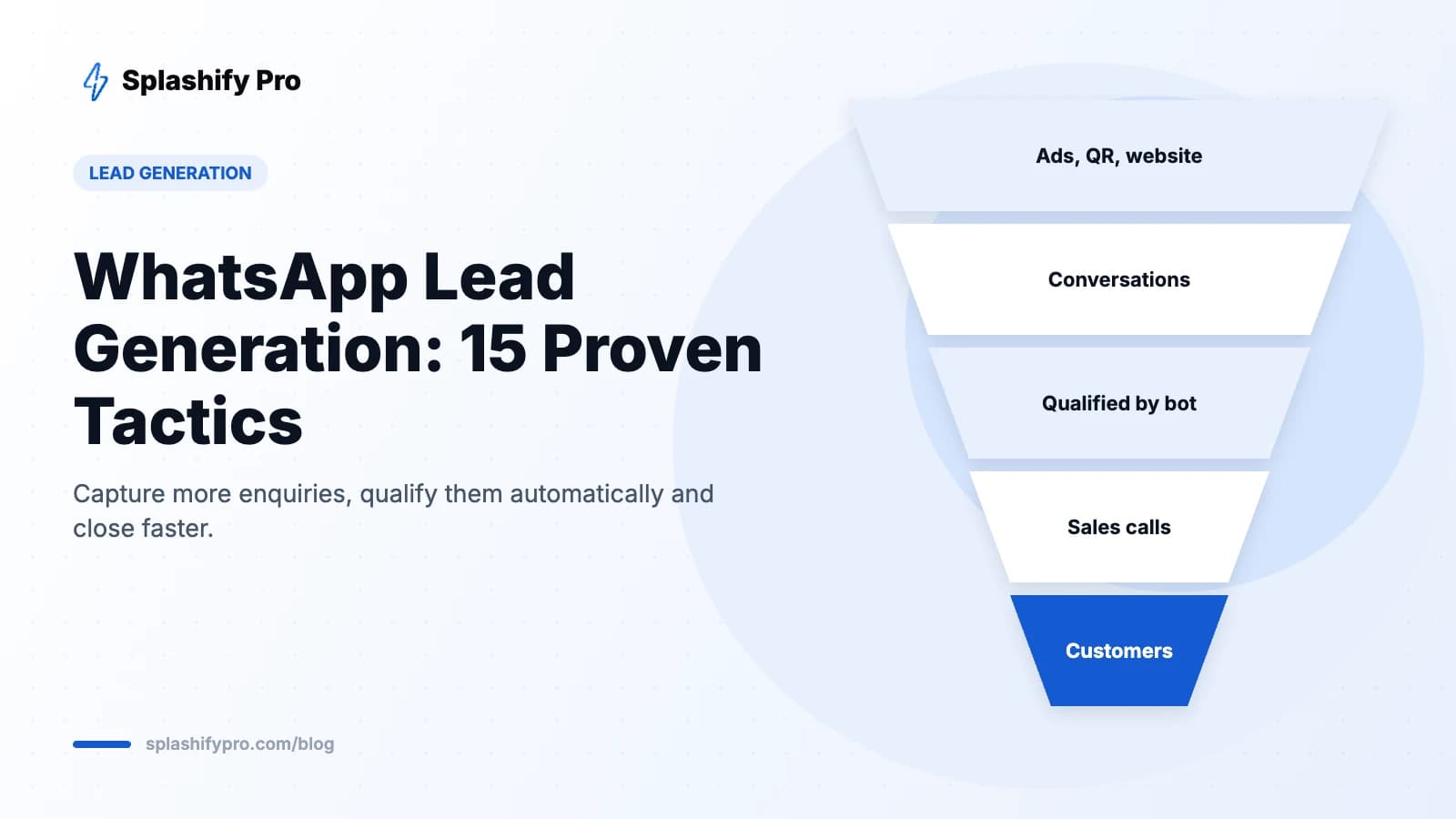
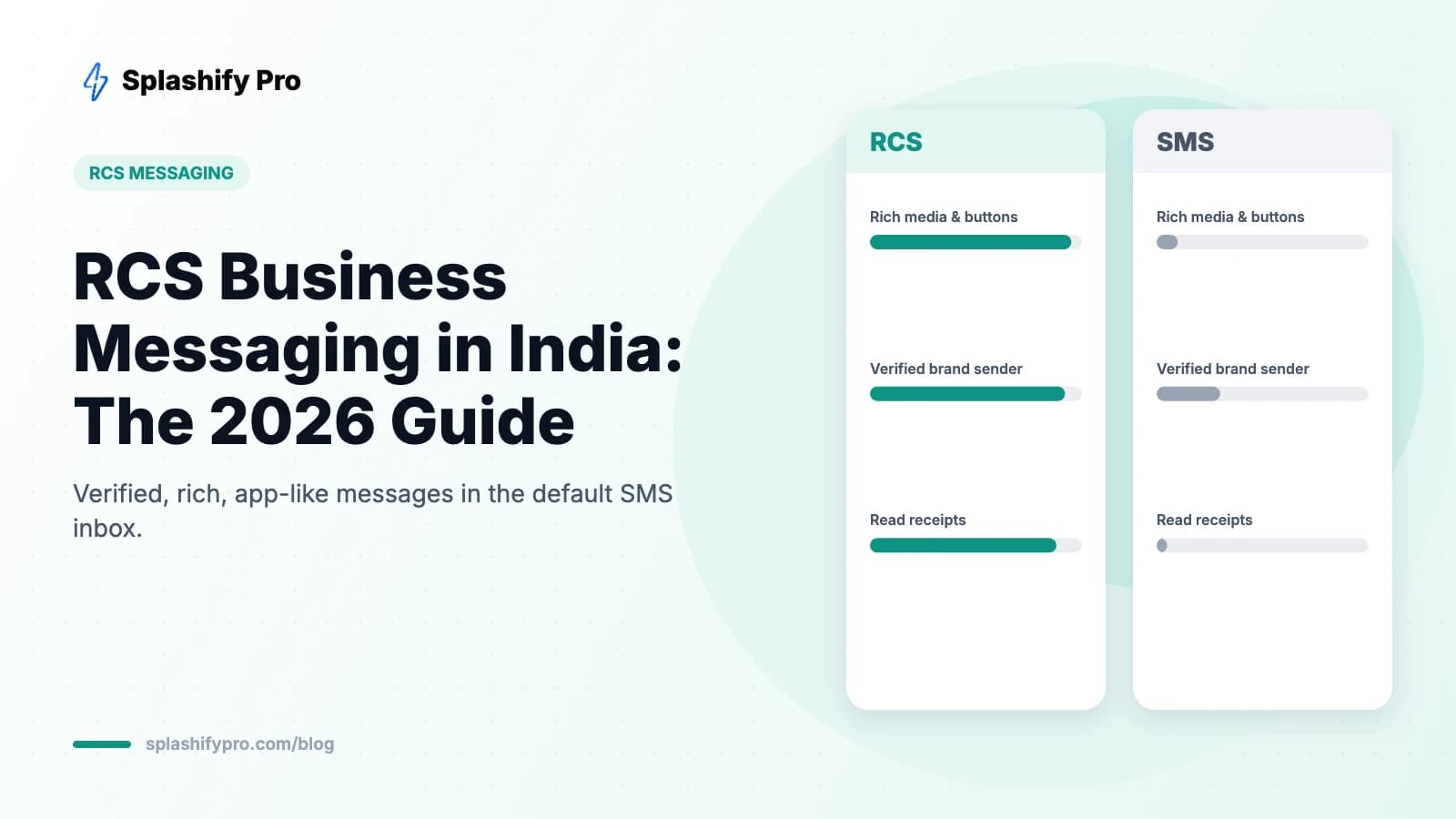
SMS has been the default business messaging channel in India for two decades — cheap and universal, but plain text from a cryptic sender ID that customers increasingly ignore. RCS (Rich Communication Services) business messaging upgrades that experience inside the same default messaging app: your verified brand name and logo, images, carousels, buttons and read receipts, with no app download required.
Here's how RCS business messaging works in India in 2026, how pricing is structured, and how to launch your first campaign. New to RCS? Start with What is RCS messaging?
How RCS business messaging works
RCS business messages are delivered through Google's RCS Business Messaging (RBM) platform and mobile operators to the user's default messaging app — Google Messages on most Android phones. Indian operators support RCS, so a large share of Android users can receive rich messages in their regular SMS inbox.
Your business appears as a verified agent with its name, logo, brand colour and a verification badge. Users can tap buttons, swipe carousels, reply with suggested responses, open links, call you or view a location — all without leaving the messaging app.
What you can send
- Rich cards — an image or video with a title, description and up to several buttons.
- Carousels — multiple swipeable cards, ideal for product catalogues or offers.
- Suggested replies — quick-tap responses like “Yes”, “Track order” or “Talk to agent”.
- Suggested actions — open a URL, dial a number, share location, add to calendar.
- Plain text messages — for simple notifications.
How RCS pricing is structured in India
RCS isn't priced per conversation like WhatsApp. Google's RBM model bills by message type, and providers pass these through with their own pricing. The main types are:
| Type | What it covers |
|---|---|
| Basic message | A short text-only message (up to 160 characters) with no rich elements |
| Single (rich) message | A longer text message or one containing rich cards, media or suggestions |
| Conversation | A session in which the user replies, billed as a conversation for a period |
Actual rupee rates depend on your provider, volume and use case (promotional vs transactional). Splashify Pro shows per-message RCS pricing transparently in your dashboard and wallet. Only messages successfully delivered over RCS are billed as RCS; undelivered messages can fall back to SMS at SMS rates.
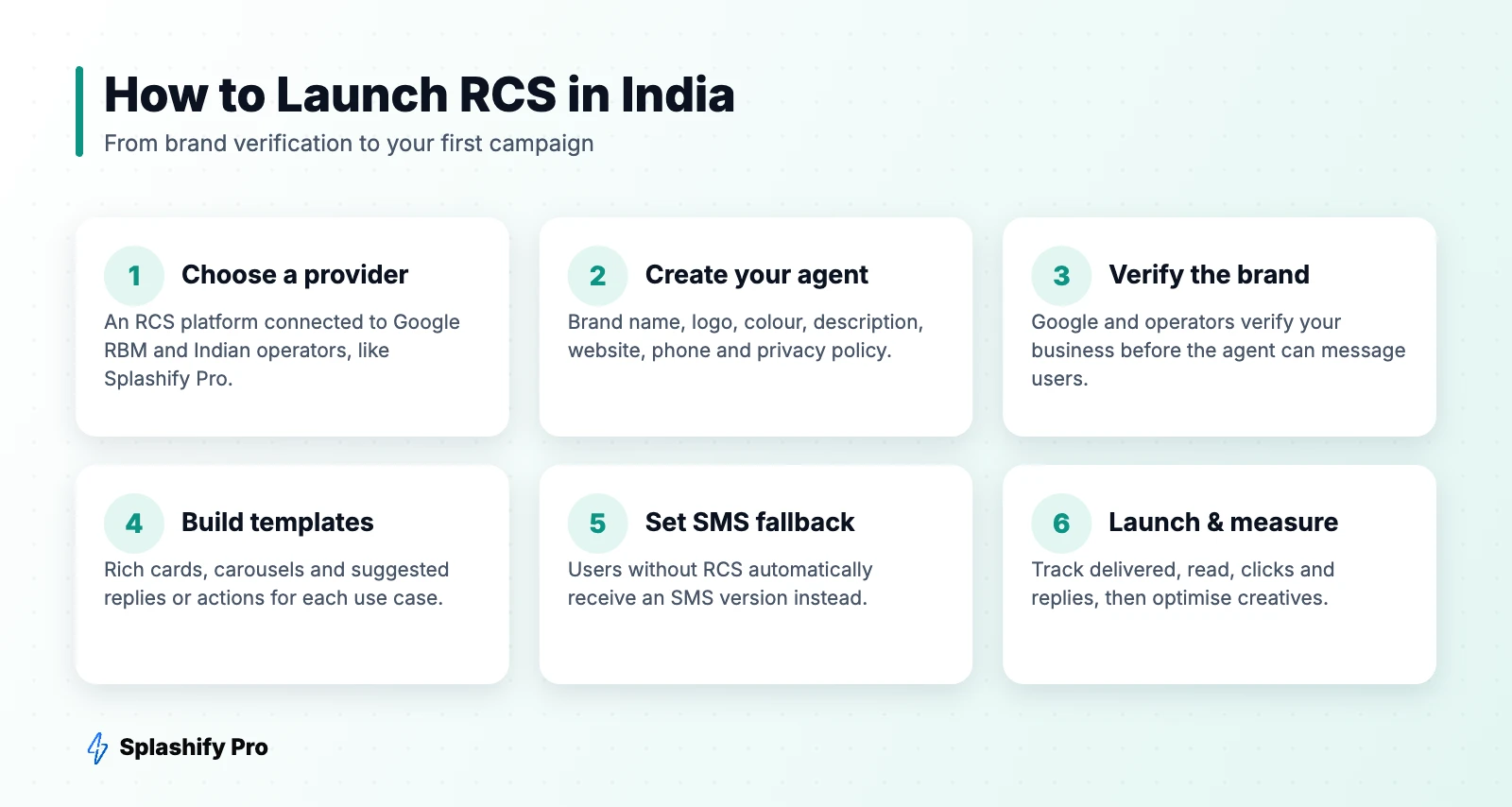
How to get started
- Choose an RCS provider connected to Google RBM and Indian operators.
- Create your agent with brand name, logo, banner, colour, description, website, support phone and privacy policy.
- Submit for verification. Google and the operators verify that your business owns the brand. This typically takes from a few days to a couple of weeks.
- Design templates for each campaign — rich cards and carousels with clear calls to action.
- Configure SMS fallback so users whose phones don't support RCS still receive the message.
- Send a test, then launch and track delivery, read and click metrics.
Use cases that work well
- Promotions and festive sales — a carousel of Diwali offers with “Shop now” buttons beats a 160-character SMS.
- Banking and fintech alerts — verified sender branding helps fight phishing and builds trust.
- E-commerce updates — order confirmation with product image and “Track order” button.
- Travel and hospitality — boarding passes, booking confirmations and check-in reminders with maps.
- Lead generation — “Book a test drive” or “Get a callback” suggested replies capture intent instantly.
- OTPs and transactional messages — branded and verified, with SMS fallback.
RCS vs SMS vs WhatsApp
RCS sits between SMS and WhatsApp. It reaches users in the default inbox without needing them to opt into a third-party app, supports rich media like WhatsApp, and falls back to SMS for universal reach. WhatsApp offers deeper two-way conversations, catalogs, payments and a huge active user base. Many Indian brands now use all three. See our detailed RCS vs WhatsApp vs SMS comparison.
Best practices
- Lead with a strong image. The visual is what gets attention in the inbox.
- One goal per message. Two buttons maximum for promotions.
- Use suggested replies to make two-way engagement effortless.
- Respect frequency and consent. Follow TRAI and operator rules for promotional messaging.
- Always configure fallback so no customer misses a transactional message.
Frequently asked questions
Do customers need to install an app for RCS?
No. RCS messages arrive in the default messaging app (Google Messages on most Android phones) as long as RCS is enabled.
Does RCS work on iPhones in India?
Apple added RCS support in recent iOS versions, but business messaging availability on iPhone depends on carrier and market rollout. Your provider can confirm current reach; SMS fallback covers the rest.
Is RCS cheaper than WhatsApp?
It depends on message type and volume. Basic RCS messages are generally priced close to SMS, while rich messages cost more. Compare against your use case and engagement.
Do I need DLT registration for RCS?
RCS has its own brand and agent verification. If you use SMS fallback, your SMS headers and templates still need DLT registration.
The bottom line
RCS gives Indian businesses an upgrade from plain SMS to branded, interactive messages in the inbox customers already check. Start with one high-value use case, design a strong rich card, and keep SMS fallback on. Launch RCS campaigns with Splashify Pro.
- #google rbm
- #rcs business messaging india
- #rcs messaging
- #rcs pricing india