
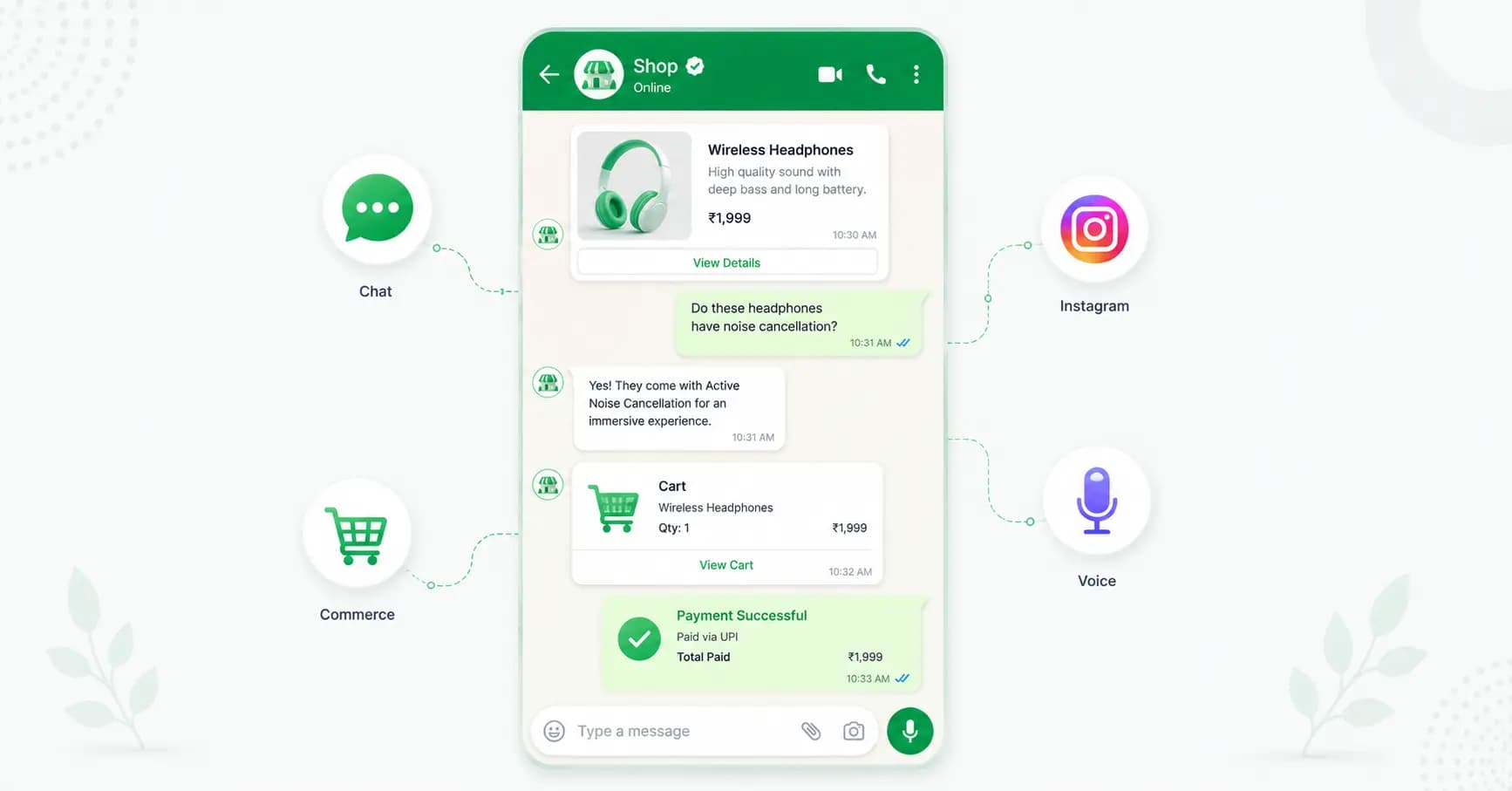
The way people buy has quietly flipped. Instead of clicking through a website, filling a form, and waiting on an email, customers now message a business, ask a question, get a recommendation, and pay — all in one chat. That's conversational commerce, and in 2026 it's one of the fastest-growing forces in retail. This guide explains what it is, why it matters, and how to make it work for your business.
What is conversational commerce?
Conversational commerce is the practice of buying and selling through conversation — letting customers browse products, ask questions, get recommendations, place orders, make payments and get support inside a messaging or chat interface, rather than a traditional web funnel.
It happens across WhatsApp, Instagram, live chat, AI assistants and voice — anywhere a real-time, back-and-forth conversation replaces static pages and forms. Instead of forcing a customer through a rigid funnel, you meet them in a chat with recommendations, reminders and support in one continuous thread. As the shift is often summed up: the brands winning in 2026 aren't the ones with the prettiest websites — they're the ones having the best conversations.
Why conversational commerce matters now
This isn't a niche experiment. By the numbers:
- It's a huge, fast-growing market. Analysts value conversational commerce at roughly $12–30 billion in 2026, growing at 12–15% a year and heading toward tens of billions by the end of the decade — one of the fastest-growing segments in digital retail. Asia-Pacific holds the largest share.
- The channel is massive. WhatsApp alone has over 3.3 billion users, and WhatsApp commerce drove an estimated $45 billion in global sales in 2026.
- It converts. WhatsApp conversational commerce sees conversion rates of 45–60% — up to 12× higher than traditional digital channels, with ~98% open rates.
- Businesses are all-in. Around 84% of e-commerce brands now treat conversational commerce as a strategic pillar, and 91% of consumers expect real-time assistance from businesses.
The customer behaviour behind this is telling: roughly two-thirds of people who start a WhatsApp conversation with a business go on to buy, and around 69% say they're more likely to purchase from a company that's reachable on WhatsApp at all.
Five shifts that make it durable (not a fad)
Conversational commerce is growing because of structural changes, not hype:
- AI made it scalable. Until recently, every conversation needed a human, making it expensive. Modern AI agents handle hundreds of conversations at once at roughly a twelfth of the cost of human support — so conversational commerce finally scales.
- In-chat payments arrived. Customers can now pay inside the chat — in India, WhatsApp Pay and UPI let people complete a purchase without leaving the conversation, reducing cart abandonment by around 30% versus mobile-web checkout.
- Expectations changed. Shoppers now lead the buying journey through questions, not page clicks, and expect instant answers.
- Competition is forcing it. With the majority of brands investing, laggards lose market share.
- Emerging markets prefer it. In India, MENA, Southeast Asia and Africa, customers strongly favour conversational channels over websites.
The channels of conversational commerce
- WhatsApp — the dominant channel, especially in India, Brazil and emerging markets.
- Instagram — DMs, story replies and comment automation turn social discovery into conversations. (See our Instagram automation guide.)
- RCS — rich, branded messages with payment buttons in the native Android inbox.
- AI agents — the intelligence layer that makes conversations scalable across every channel.
- Voice — voice assistants and AI voice, an emerging frontier.
The conversational commerce journey
Conversational commerce spans the entire customer journey — inside one chat thread:
- Discovery — customers find you through Click-to-WhatsApp ads, a link or a QR code, and browse your catalogue in chat.
- Questions — an AI agent answers product questions instantly, compares options and makes recommendations.
- Purchase — customers order and pay in the chat, via WhatsApp Pay, UPI or a payment link — no redirect. (See how to sell on WhatsApp.)
- Recovery — abandoned carts are recovered with a timely nudge, at 15–30% vs 2–5% for email.
- Post-purchase — order updates, support and re-engagement keep the relationship going, driving around 2× repeat purchase rates.
Conversational commerce in India
India is the epicentre of conversational commerce, and it has its own playbook:
- WhatsApp is default. With 500M+ users (projected to cross a billion by end of 2026), it's where Indian buyers already are.
- Payments are built in. UPI processed over 16 billion transactions in a single month in late 2025, and WhatsApp Pay lets customers pay in-chat — a huge abandonment reducer.
- COD still matters. Cash-on-delivery confirmation flows (and converting COD to prepaid) are essential locally.
- Language and voice. Local languages and voice notes are how many Indian customers prefer to communicate.
- Mobile-first. Over 95% of shopping happens on smartphones, making chat the natural interface.
How to get started with conversational commerce
You build it from a few core pieces:
- Get on the WhatsApp Business API — the foundation for messaging at scale.
- Set up a catalogue and payments — so customers can browse and buy in chat.
- Add an AI agent or chatbot — to answer questions, recommend products and qualify buyers 24/7.
- Drive discovery with Click-to-WhatsApp ads — turning ad taps into conversations.
- Automate recovery and retention — cart recovery, order updates and re-engagement.
- Add a human layer — a shared inbox so agents handle what AI escalates.
Best practices
- Meet customers where they are — in chat, on the channels they already use daily.
- Respond instantly — speed directly drives conversions and recovery.
- Personalise — use customer data and history; tailored beats generic every time.
- Pair AI with humans — let AI handle volume and escalate the complex.
- Make paying frictionless — in-chat payments (WhatsApp Pay, UPI, links) reduce drop-off.
- Respect consent — message opted-in customers and make opting out easy.
How Splashify Pro powers conversational commerce
Conversational commerce needs the whole journey in one platform — and that's exactly what Splashify Pro delivers. Run discovery through Click-to-WhatsApp ads; let AI agents answer questions, recommend products and qualify buyers; sell with a catalogue, store and in-chat payments; recover carts and automate order updates; and manage it all across WhatsApp, Instagram and RCS — with email and Voice AI on top — from one INR-native dashboard. It turns conversations into a complete commerce engine.
Frequently asked questions
What is conversational commerce?
Conversational commerce is buying and selling through conversation — letting customers browse, ask questions, get recommendations, order, pay and get support inside a messaging or chat interface like WhatsApp, rather than a traditional website funnel. It spans messaging apps, AI chatbots and voice.
What is an example of conversational commerce?
A customer taps a WhatsApp ad, asks about a product, gets a recommendation from an AI agent, places the order and pays via UPI — all in one chat, then receives shipping updates on the same thread. Brands like Sephora and Zara use conversational shopping to drive high appointment and conversion rates.
Why is conversational commerce important?
Because customers now expect to buy through conversation, and it converts far better than static funnels — WhatsApp conversational commerce sees 45–60% conversion rates, around 98% open rates, and much higher cart recovery than email. With 84% of e-commerce brands investing in it, it's becoming essential rather than optional.
What channels are used for conversational commerce?
Mainly WhatsApp (the dominant channel, especially in India and emerging markets), plus Instagram, RCS, live chat, AI assistants and voice. WhatsApp leads because of its huge reach, high engagement and in-chat payment support.
How big is the conversational commerce market?
Analysts estimate the global conversational commerce market at roughly $12–30 billion in 2026, growing at about 12–15% a year and projected to reach tens of billions of dollars by the early 2030s — one of the fastest-growing areas in digital retail, with Asia-Pacific holding the largest share.
How do I start with conversational commerce?
Get on the WhatsApp Business API, set up a catalogue and in-chat payments, add an AI agent or chatbot to handle questions, drive traffic with Click-to-WhatsApp ads, and automate cart recovery and order updates — with a shared inbox for human handoff. A platform like Splashify Pro brings all of this together.
Is conversational commerce the same as e-commerce?
Not quite. E-commerce traditionally means shopping via a website or app. Conversational commerce means shopping through conversation — chat, messaging and AI. It often complements e-commerce (recovering carts, answering questions, taking orders in chat) and increasingly replaces the website funnel entirely for discovery and purchase.
The bottom line
Conversational commerce is the shift from making customers navigate your funnel to simply talking with them — discovering, deciding and buying in one chat. It's a fast-growing, multi-billion-dollar movement, and in India especially, WhatsApp has made it the default way business gets done. The brands that win won't be the ones with the flashiest sites — they'll be the ones having the best conversations, at scale.
Build your conversational commerce engine with Splashify Pro → — ads, AI agents, catalogue, payments and recovery across WhatsApp, Instagram and more. Start free for 14 days.
- #chat commerce
- #conversational commerce
- #conversational commerce 2026
- #conversational commerce india
- #conversational commerce whatsapp
- #what is conversational commerce